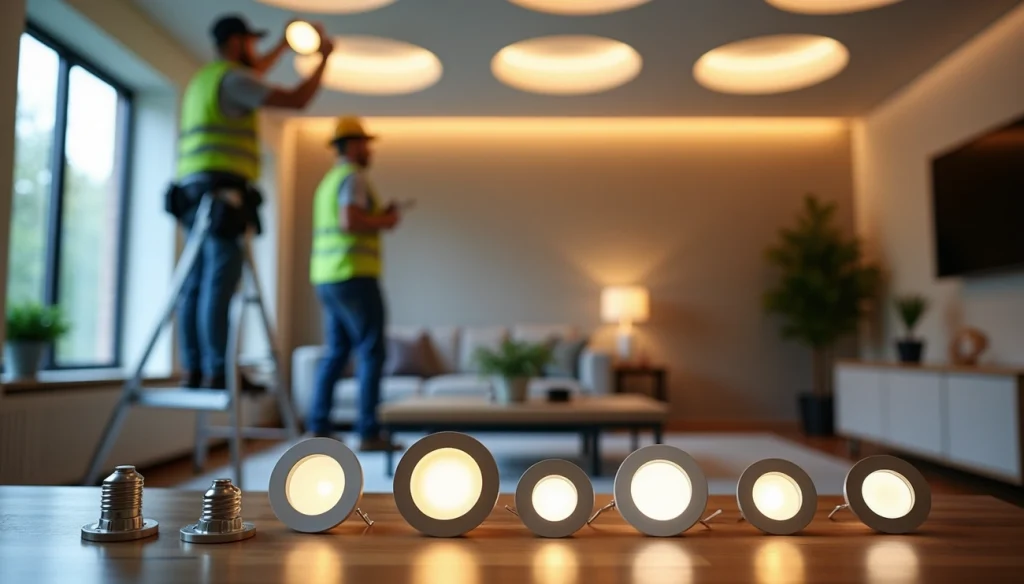
Did you know that pot light installation cost can range from $100 to $500 per fixture when you factor in all expenses? That’s right – what seems like a straightforward lighting upgrade can quickly add thousands to your renovation budget.
Surprisingly, many homeowners underestimate these costs, focusing only on the price of fixtures while overlooking labor, wiring, and potential ceiling modifications. When planning a lighting renovation, understanding the complete financial picture becomes essential for avoiding budget overruns.
The actual price you’ll pay depends on several factors: fixture quality, ceiling type, installation complexity, and your location. For example, installing pot lights in new construction typically costs less than retrofitting them into existing ceilings where drywall cutting and patching are required.
This comprehensive guide breaks down every aspect of pot light installation pricing for 2025, from materials to labor to regional variations. Whether you’re renovating your kitchen, brightening your basement, or building a new home, you’ll discover exactly what influences these costs and how to plan effectively for your lighting project.
How Much Do Pot Lights Cost in 2025?
In 2025, the national average for pot light installation hovers around $1,800 for a standard project, though costs can vary significantly based on several factors [1]. Understanding these costs before starting your lighting project helps prevent budget surprises.
Average cost per fixture
The typical cost per pot light ranges from $100 to $300 per fixture [1]. However, this range can extend from as low as $81 to as high as $407 depending on quality, installation complexity, and your specific needs [2]. Breaking down these costs reveals:
- Basic fixtures: $15-$50 each for simple LED options [3]
- Mid-range fixtures: $60-$120 each for better quality and dimmable features [3]
- Premium fixtures: $100-$200 each for smart technology and superior color rendering [3]
Additionally, installation costs account for a substantial portion of the per-fixture price. Professional electricians typically charge between $81 and $163 for labor per fixture [2]. Consequently, when planning your budget, remember that the visible fixture is only part of the total investment.
Typical total project range
For most homeowners, the complete pot light installation project falls between $1,000 and $2,500 [4]. However, projects can range dramatically from $300 for minimal work to $8,000 for extensive lighting systems [1].
Project scope dramatically affects total costs:
| Project Size | Typical Cost Range |
| Single Room (6 lights) | $900-$2,400 [5] |
| Kitchen (6-10 lights) | $1,000-$3,000+ [2] |
| Living Room (6-8 lights) | $900-$2,400 [2] |
| Basement (8-12 lights) | $1,200-$3,000+ [2] |
Furthermore, installation type significantly impacts your total project cost. Retrofitting existing ceilings typically costs 20-30% more than new construction installations [5]. This price difference occurs because retrofit projects require cutting into existing drywall, fishing wires through finished walls, and patching afterward.
Cost differences by region
Where you live plays a major role in determining your final pot light installation costs. Labor and material prices vary substantially across different regions of the country, particularly between urban and rural areas [1].
Consider these regional price variations for installing six mid-range LED pot lights:
- Houston, TX: Approximately $1,600 total ($944 for labor at $118/hour) [2]
- Los Angeles, CA: Around $1,880 total ($1,176 for labor at $147/hour) [2]
- New York, NY: About $2,100 total ($1,360 for labor at $170/hour) [2]
Urban and coastal regions generally command higher prices due to increased demand and higher cost of living. In contrast, rural areas might offer lower labor rates but could include additional charges for material delivery [1].
Beyond geography, your home’s specific location affects pricing too. Installing pot lights in bathrooms or kitchens often costs more ($275-$725) than bedrooms or hallways ($100-$200) due to special fixture requirements and more challenging spaces [2].
Breaking Down the Cost: Fixtures, Trim, and Bulbs
Understanding the components of pot lights helps explain where your money goes during installation. The cost breakdown involves three main elements: fixtures (housing), trims, and bulbs—each contributing differently to your total investment.
Fixture types and price ranges
The housing or “can” represents the foundation of recessed lighting, with prices varying based on type and features. Basic recessed light fixtures typically cost between $15 and $100 per unit [6], although specialty options may exceed this range.
Pot light fixtures come in two primary categories:
- New construction fixtures: Ideal for open ceilings or new builds, these offer easier access and lower labor costs [7]
- Retrofit/remodel kits: Designed for installation in existing ceilings without major demolition, slightly increasing labor costs [7]
Another critical distinction exists between insulation compatibility:
- IC-rated fixtures: Safely contact insulation, often required by building codes [7]
- Non-IC-rated fixtures: Must remain at least 3 inches from insulation, typically less expensive [8]
In 2025, you’ll find fixture pricing varies substantially by quality tier:
- Economy fixtures: $10-$20 per unit
- Standard fixtures: $20-$50 per unit
- Premium fixtures: $50-$100+ per unit
Trim styles and their impact on cost
The trim—visible portion extending from the housing—affects both appearance and cost. Various styles serve different purposes:
Baffle trim features a ribbed interior that reduces glare, representing the most common and cost-effective option [9][8]. Reflector trim, conversely, contains a mirrored surface that maximizes light output [9].
For directional lighting needs, eyeball trim offers complete 360-degree rotation, whereas gimbal trim allows tilting or rotating the light source [8]. Both typically cost 15-30% more than standard options.
Wall wash trim covers half the light to direct illumination in one direction—perfect for highlighting artwork or wall features [8]. For wet locations, shower trim includes tempered glass and watertight sealing, commanding premium pricing [9][8].
Bulb types: LED, halogen, smart options
Your bulb selection dramatically impacts both upfront costs and long-term expenses:
LED bulbs dominate the market in 2025, costing $5-$30 each [2]. They offer exceptional value despite higher initial prices:
- Use 80-90% less electricity than traditional options [10][11]
- Last 15,000-50,000 hours (15+ years of typical use) [10][11]
- Produce minimal heat, enhancing safety [10]
- Available in multiple color temperatures (2700K-6000K) [10]
Halogen bulbs represent an older technology with some remaining applications:
- Among the least expensive options upfront [10]
- Significantly shorter lifespan of only 1,000-2,000 hours [10][11][12]
- Generate substantial heat, presenting potential safety concerns [10]
- Higher long-term costs due to frequent replacement and energy usage [11]
Smart bulbs offer advanced features at premium prices:
- Typically cost $25-$150 per bulb, 2-5 times more than standard LED options [10][2]
- Allow control via smartphone apps or voice assistants [2]
- Feature adjustable brightness and sometimes color changing capabilities [2]
- May require compatible switches, hubs, or gateways [2]
Understanding these component costs helps you make informed decisions about your pot light installation project, balancing upfront investment against long-term performance and operating expenses.
Labor and Installation Costs Explained
Labor often represents the largest portion of your pot light installation budget. Understanding the various factors that influence these costs helps you plan your lighting project more effectively.
Electrician hourly rates
Licensed electricians typically charge between $65 and $125 per hour for pot light installation services [3]. These rates vary considerably based on location, experience level, and job complexity. In certain metropolitan areas like Brooklyn, rates can range from $50 to $130 per hour [13].
Many professionals also apply additional charges:
- Service call fees: $100 to $200 [13]
- Trip charges: $40 to $100 covering travel time [13]
- Minimum charges: Often 1-2 hours regardless of actual time spent [13]
For emergency services during weekends or holidays, expect to pay 1.5 to 2 times the standard rate [13]. Electricians sometimes offer flat rates per fixture rather than hourly billing, especially for straightforward installations.
Time required per fixture
Professional installation typically requires 1-2 hours per fixture [3], though this timeframe varies based on several factors:
| Installation Type | Average Time Per Fixture |
| New construction | 1-1.5 hours |
| Retrofit projects | 2-4 hours |
| Complex wiring | 2.5+ hours |
According to industry experts, a complete installation involving 4 recessed lights takes approximately 2-4 hours with an experienced electrician and assistant [1]. Installing each pot light involves numerous steps including ceiling cutting, wiring, fixture mounting, and sometimes drywall repair.
Permit and inspection fees
Many municipalities require electrical permits for pot light installation, especially when adding new circuits. Permit costs typically range from $50 to $250 [3], with fees varying significantly based on location and project scope.
In high-regulation states like California or Massachusetts, expect to pay toward the higher end of this range [3]. Some jurisdictions mandate inspections after completion to ensure code compliance, adding an extra step to your installation process.
Skipping required permits can lead to serious consequences:
- Potential fines (some municipalities charge 4 times the original permit cost for unpermitted work) [4]
- Complications during home sale inspections
- Insurance coverage issues if electrical problems occur [3]
Your electrician often handles permit applications and coordinates inspections as part of their service, sometimes including these fees in their overall quote [3].
Accessibility and ceiling height impact
The physical characteristics of your installation location significantly affect labor costs. High ceilings (9 feet or taller) require special ladders or scaffolding, increasing installation expenses by $41 to $162 per fixture [5].
Ceiling types also play a crucial role in determining installation complexity:
- Flat ceilings: Easiest and most affordable option [3]
- Vaulted or cathedral ceilings: Increase both time and difficulty [3]
- Dropped ceilings: May present access challenges [14]
Access to wiring spaces similarly impacts costs. If your installer has easy attic access or open joists, labor proceeds more quickly and affordably [3]. Alternatively, limited access necessitates additional drywall removal, subsequently requiring repairs that include patching, mudding, taping, sanding, and repainting [1].
Outdoor pot light installation involves additional expenses since everything must be properly weather- and water-proofed [14], often requiring specialized fixtures and installation techniques.
Installation Types: New Build vs. Retrofit vs. DIY
The installation approach you choose for pot lights significantly impacts your final cost. First and foremost, understanding the differences between installation types helps determine which option makes financial sense for your specific situation.
New construction vs. existing ceiling
New construction installation occurs when ceiling joists are exposed before drywall installation. This method offers several advantages:
- Metal arms attach directly to ceiling joists, providing stronger support [15]
- Installation costs are typically 20-30% lower than retrofit options [9]
- Allows for more fixture choices and placement flexibility [16]
In contrast to new builds, existing ceiling installation (retrofit) involves working with finished drywall. These fixtures use spring-loaded clips that secure against the drywall itself instead of joists [15]. Even though this requires less demolition, labor costs increase to approximately $125-$300 per fixture for retrofit versus $65-$175 for new construction [17].
Retrofit kits and surface mount options
Modern retrofit solutions have evolved beyond traditional “can” lights. Canless LED lights (also called wafer LEDs) combine the LED, driver, and housing into a single thin unit [15]. These fixtures:
- Require only a small ceiling hole
- Install with spring clips against drywall
- Fit into shallow ceiling cavities where traditional cans cannot [15]
Surface-mount alternatives eliminate the need for ceiling penetration altogether. These “can-style” lights resemble traditional recessed lighting but attach directly to the ceiling surface [18].
DIY installation cost and tools needed
Taking the DIY route can significantly reduce expenses. Materials alone typically cost $50-$150 per light [17], making a six-light project approximately $300-$800 without labor [19]. Necessary tools include:
- Hole saw or drywall saw
- Voltage tester
- Wire strippers
- Ladder [19]
In reality, the DIY approach demands solid electrical knowledge alongside a time investment of 1-2 hours per fixture [9].
When to hire a professional
As a result of safety concerns, professional installation remains advisable in several situations:
- Complex or outdated wiring systems [8]
- Multiple fixture installations requiring load calculations [8]
- When manufacturer warranties require professional installation [7]
- For code compliance and proper permits [7]
Licensed electricians typically charge $75-$200 per fixture or $50-$105 hourly [9], coupled with the peace of mind that comes with proper installation and reduced risk. Electrical mistakes can lead to serious hazards including short circuits, fires, or electrocution [7].
How to Save on Pot Light Installation
Smart planning can substantially reduce pot light installation costs. Implementing strategic approaches allows homeowners to achieve excellent lighting while protecting their budget.
Plan layout to reduce fixture count
Creating a thoughtful lighting plan before installation helps minimize the number of fixtures needed. First, sketch your room’s dimensions, then calculate optimal light placement. One effective approach suggests using half the ceiling height as the distance between lights [20]. For instance, a room with 8-foot ceilings might place lights 4 feet apart.
Moreover, lighting calculators help determine appropriate fixture quantities based on room size and desired brightness. Many homeowners initially overestimate needed fixtures—one case study revealed calculations suggesting nine recessed lights, yet four properly positioned lights provided sufficient illumination [20].
Use existing wiring where possible
Utilizing pre-existing wiring represents one of the most effective cost-reduction strategies. When replacing pendant lights or ceiling fans with pot lights, the established electrical connections significantly lower installation expenses [21]. In fact, switching from existing fixtures to recessed lighting becomes a relatively straightforward task because wiring infrastructure already exists [21].
Alongside this, older properties might benefit from rewiring during renovation, improving safety while facilitating pot light installation [22].
Buy during sales or use rebates
Utility companies frequently offer substantial rebates for energy-efficient lighting installations. These incentives come in two primary forms:
- Prescriptive rebates from utility companies (longer processing time)
- Midstream/instant rebates from lighting distributors (no application required, faster processing) [10]
Regional programs vary considerably—some offering incentives based on kilowatt-hour savings ($0.15/kWh for indoor lighting, $0.13/kWh for outdoor lighting), others providing percentage-based discounts (up to 70% of material costs) [11].
Bundle with other renovation projects
Combining pot light installation with broader renovation work creates multiple cost-saving opportunities. First, contractors may offer package discounts when completing several projects simultaneously. Second, ceiling access during other renovations eliminates redundant labor expenses [22].
Furthermore, ultra-thin LED fixtures reduce installation complexity compared to traditional recessed lighting, decreasing labor costs by 40-50% in large-scale projects [12]. These streamlined installations require fewer ceiling modifications and eliminate the need for housing cans.
Conclusion
Pot light installation represents a significant investment that demands careful planning and budgeting. The total cost depends on numerous factors, from fixture quality and installation complexity to regional labor rates. Most homeowners spend between $1,000 and $2,500 for a complete project, though prices can vary dramatically based on specific circumstances.
Careful consideration of your lighting needs before installation helps prevent unnecessary expenses. Rather than simply maximizing fixture count, strategic placement often achieves better results while reducing costs. Additionally, choosing the right installation approach makes a substantial difference—retrofit projects typically cost 20-30% more than new construction installations.
Smart shoppers can reduce expenses through several proven strategies. Using existing wiring whenever possible eliminates significant labor costs. Rebates and sales opportunities further lower material expenses. Bundling pot light installation with other renovation work creates even more savings through shared access and contractor efficiency.
The decision between DIY and professional installation deserves thorough evaluation. While DIY projects save labor costs, they require solid electrical knowledge and appropriate tools. Professional electricians provide expertise, safety, and peace of mind—particularly valuable for complex installations or when manufacturer warranties demand professional installation.
Undoubtedly, pot lights enhance both functionality and esthetics in any space. Though the initial investment might seem substantial, quality fixtures and proper installation deliver lasting value through improved lighting, energy efficiency, and home appeal. With this comprehensive guide, you now have the knowledge needed to plan your pot light installation project effectively and avoid budget surprises in 2025.
References
[1] – https://www.justanswer.com/electrical/f661i-hours-electrician.html
[2] – https://vietshopdesign.com/recessed-lighting-installation-cost/?srsltid=AfmBOoplqgpLydgYU_527RMgRNWJuBUVP2wuSDrC4_woRaesgZhVWePI
[3] – https://vietshopdesign.com/recessed-lighting-installation-cost/?srsltid=AfmBOoo0An9cRv3i2viPvlDnCQPTLd7n_4HtRjR863ZoPf0HML0Wl5lr
[4] – https://permits.cityofomaha.org/fees
[5] – https://indochinalight.com/blogs/lighting-cost/recessed-lighting-installation-cost
[6] – https://www.paclights.com/explore/how-much-is-recessed-lighting-lighting-engineers-guide/
[7] – https://juggernaut-electric.com/blog/the-importance-of-hiring-a-licensed-electrician-for-recessed-lighting-installation
[8] – https://www.nuwattlighting.com/blogs/news/do-you-need-an-electrician-to-replace-recessed-lights?srsltid=AfmBOooCMkt4ggntC2U_m5_VEmRwNeQqd6nHcdg0EGB7jJ6al3dQlu7U
[9] – https://www.rowabi.com/blogs/lab-of-wabi-sabi-blogs/cost-to-install-recessed-lighting?srsltid=AfmBOooNjRCVkcx92tdLWRWKmeI8wkZf25l8XD-Ns-Pbx8pbAP8CE4ve
[10] – https://www.tcpi.com/rebates/
[11] – https://energyright.com/business-industry/incentives/led-lights/
[12] – https://magiclite.com/news/how-5cct-ultra-thin-recessed-lights-deliver-maximum-roi/
[13] – https://davenelectric.com/how-much-does-it-cost-to-hire-licensed-electrician/
[14] – https://hi-liteelectricinc.ca/about-us/blog/general-category/pot-light-installation-costs-in-2025/
[15] – https://www.lightdot.com/blogs/news/whats-the-difference-between-new-construction-and-remodel-recessed-light-housings?srsltid=AfmBOoqR2WF5_v3RifUabc0If753q1eL3srllDDJcqMhokzA-YHh4xlK
[16] – https://www.recessedlightingoc.com/remodel-versus-new-construction/
[17] – https://homeguide.com/costs/cost-to-install-recessed-lighting
[18] – https://diy.stackexchange.com/questions/169323/can-i-install-new-construction-lights-into-old-ceiling-with-attic-vs-remodel-lig
[19] – https://www.angi.com/articles/how-much-does-it-cost-install-recessed-lighting.htm
[20] – https://fixthisbuildthat.com/how-to-install-recessed-lighting-in-existing-ceiling/
[21] – https://www.fergusonhome.com/how-to-install-recessed-lighting/a21658?srsltid=AfmBOoruymuDxtigFyz_EeuYTuquWFkgRapPITfOwsURFrXFLuftghzv
[22] – https://www.vision-lighting.co.uk/Blog/The-Cost-Savings-of-Recessed-Lighting