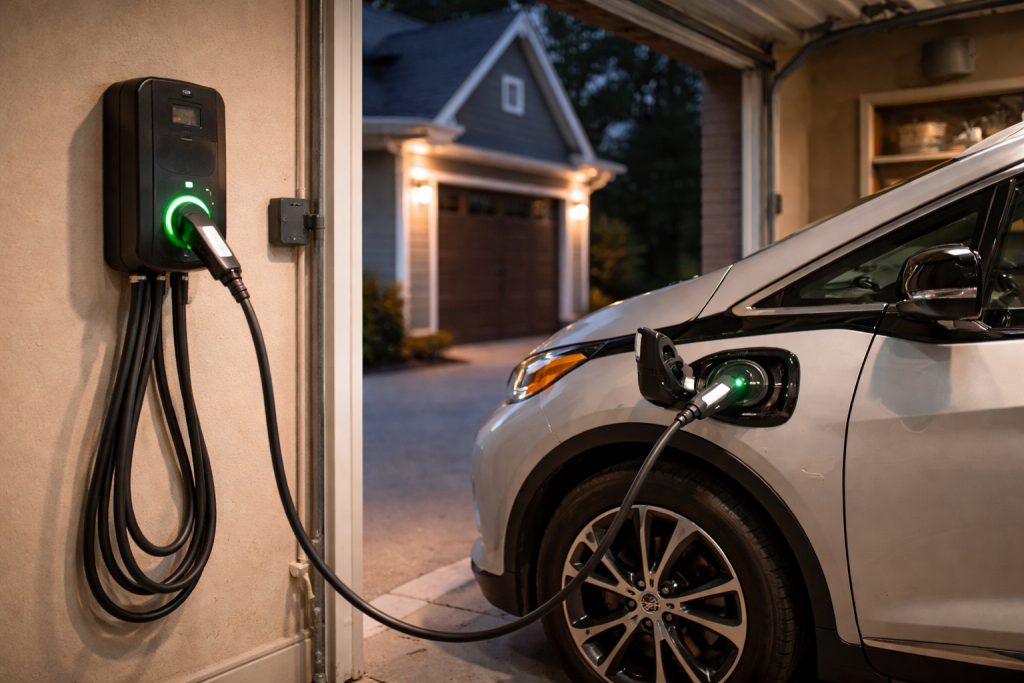
The power consumption of your home EV charger might surprise you. A Level 2 EV charger draws about 7,200 watts (7.2 kilowatts) of electricity. This power draw is nowhere near a standard electric furnace’s 10,000 watts but exceeds a water heater’s 4,500 watts.
Your EV battery’s charging requirements depend on wattage and usage patterns. Level 2 home chargers deliver between 3.3 to 19.2 kilowatts based on the unit and provide about 20-30 miles of range per hour. The average EV owner’s monthly consumption reaches 408 kilowatt-hours for car charging. This translates to costs of $57.90 per month or $695 annually.
Your electricity bill might benefit from a key fact – 90% of electric car charging occurs overnight at home with lower rates. The global EV count surged by 60% in 2022 to 26 million. This makes your EV charger’s power consumption a crucial factor in managing your home’s energy use.
Understanding EV Charger Power in Watts and kWh
You need to grasp two basic electrical measurements that control charging to understand your EV’s power usage. These concepts help calculate costs and charging times.
What is the difference between watts and kilowatt-hours?
EV owners must know the difference between watts and kilowatt-hours. Kilowatts (kW) measure electrical power’s flow rate. Think of kW as electricity’s speed, like water flowing from a garden hose.
Kilowatt-hours (kWh) measure the total electricity used over time. Put simply, kWh equals kW times hours. A 22 kW charger running for one hour uses 22 kWh of electricity.
To cite an instance, see this comparison: kWh works like your EV battery’s capacity (similar to a gas tank’s gallons), while kW shows your charger’s power (like a fuel pump’s speed).
How many watts does an EV charger use per hour?
Power usage varies based on charger type:
- Level 1 Chargers: Standard 120V outlet chargers use about 1,400-1,900 watts and add 2-5 miles of range hourly.
- Level 2 Chargers: These 240V outlet chargers use 3,300-19,200 watts. Home Level 2 chargers average 7,200 watts (7.2 kW).
- DC Fast Chargers: Commercial chargers run at 50,000-350,000 watts (50-350 kW) and provide quick charging at public spots.
Your EV’s onboard charger limits charging speed whatever the station’s power. Modern EV onboard chargers handle 6.6-11 kW.
Why this matters for your electric bill
These measurements affect your costs. Utility companies bill by kilowatt-hours, so knowing your EV‘s usage helps predict expenses.
EVs use about 0.35 kilowatt-hours per mile. This means 13 kWh daily for a typical 37-mile commute, or 390 kWh monthly.
Home EV charging adds about a third to a regular household’s monthly power usage. Utility companies offer time-of-use rates that make overnight charging cheaper.
EVs cost less than gas vehicles. Gas cars cost 6.7 cents per mile while electric vehicles run at 3.8 cents per mile—43% cheaper.
Wattage Breakdown by Charger Type
EV chargers come in three types that deliver different power levels based on your needs. Let’s look at how much power these chargers actually use.
Level 1 Chargers: 1,400–1,900 watts
Level 1 chargers connect to standard 120-volt household outlets and use about 1,400 to 1,900 watts of power. These simple chargers add only 3-7 miles of range per hour. Your battery electric vehicle (BEV) could take 22-50 hours to charge fully from empty. Many people still use these chargers at home because you can plug them into any standard outlet.
Level 2 Chargers: 3,300–19,200 watts
Level 2 chargers use more power, between 3,300 and 19,200 watts. They work on 240-volt circuits, just like your clothes dryer. Most home Level 2 chargers put out about 7,200 watts and add 10-20 miles of range each hour. You can fully charge most BEVs in just 4-10 hours. This makes them perfect for everyday drivers.
DC Fast Chargers: 50,000–350,000 watts
DC Fast Chargers use very high power levels—between 50,000 and 350,000 watts. These stations send DC power straight to your battery instead of AC power like Level 1 and 2 chargers. The huge power output charges EVs from empty to 80% in just 20-60 minutes. You’ll find these chargers mostly on highways and commercial spots to support long trips.
How vehicle type affects charging wattage
Your vehicle’s maximum charging capacity determines the actual charging speed, whatever the charger’s power rating. Each EV model has its own maximum charging rate. A car that maxes out at 50kW will only charge at that rate even when connected to a 150kW charger. Temperature plays a role too—batteries charge slower in very hot or cold weather. The battery level matters as well. The charging speed drops after 80% capacity to keep your battery healthy.
Real-World Power Usage Examples
Your EV’s power consumption depends on how you drive. These numbers will help you understand the effect on your electric bill.
How much electricity does an electric car use to charge daily?
American drivers typically cover 38.4 miles each day. A standard electric vehicle needs about 13.4 kWh of electricity daily. This number comes from the average EV’s use of 0.35 kWh per mile. Most home charging systems pull 7,200 watts (7.2 kW) of power during active charging.
Monthly and yearly kWh usage based on driving habits
EV owners use around 408 kWh monthly to charge their cars. This adds up to $57.90 per month or $695 yearly. Your location affects these costs by a lot – electricity rates vary dramatically between states. Idaho residents pay 12.5 cents per kWh while Vermont residents pay nearly 25 cents.
Power required to charge electric car by model
Different EV models need different amounts of power:
- Efficient models: 0.20 kWh/mile (233 kWh monthly)
- Average models: 0.35 kWh/mile (408 kWh monthly)
- Less efficient models: 0.50 kWh/mile (583 kWh monthly)
Comparing EV charging to common household appliances
EV charging uses 2,363 kWh yearly, which is nowhere near what other home appliances consume. A water heater needs 2,706 kWh yearly, and an electric furnace pulls about 10,000 watts while running. Adding an EV to your home typically increases your energy usage by 25-35%.
Cost and Efficiency Considerations for Homeowners
Managing your EV charging costs means understanding several key factors that affect your bottom line. Let’s look at ways to reduce your charging expenses.
How electricity rates affect charging costs
Electricity prices vary dramatically by region, which directly affects your EV charging costs. The fuel efficiency of an EV is typically measured in kilowatt-hours per 100 miles. At the national average rate of 10.7¢ per kWh, a full charge for an EV with a 200-mile range costs about $6.00. Rates across the country range from 12.5¢ per kWh in some states to nearly 25¢ in others.
Time-of-use plans and off-peak charging
Time-of-use (TOU) rates give you tiered pricing based on your electricity consumption timing. You can save 30% compared to standard rates during off-peak hours, which usually run from 8 p.m. to 6 a.m. Peak-hour rates during high-demand periods can cost three times more. Your monthly charging costs could drop by 30-50% if you schedule charging overnight. Many utilities encourage EV owners to use these plans. To name just one example, see PG&E’s off-peak charging, which costs the equivalent of paying just $2.92 per gallon at the pump.
Using solar panels to offset EV charging
Home solar power provides an affordable way to charge your EV. Solar energy costs about $0.06 per kWh on average, making it over 60% cheaper than grid electricity. The yearly cost comparison shows solar charging at $235 versus $626 for home grid power. Solar charging creates only 321 pounds of CO2 emissions per year compared to 1,837 pounds from grid power. EV owners typically need 5-8 solar panels to power their vehicle’s charging requirements.
Smart charging systems and energy savings
Smart charging technology optimizes your EV charging schedule automatically. These systems wait to charge until electricity rates drop to off-peak levels and can use excess solar power instead of sending it back to the grid. The benefits extend beyond individual savings. A study revealed that EV drivers generated $3.10 billion more in revenue than utilities spent serving them over ten years.
Conclusion
Knowledge about your EV charger’s power consumption definitely helps you make smarter energy decisions. Better understanding of watts and kilowatt-hours gives you more control over your electricity costs.
Level 2 home chargers draw about 7,200 watts and provide 20-30 miles of range per hour – making them a practical choice for most EV owners. DC chargers use a lot more power but charge quickly when you’re on the road.
Your monthly electricity bill will increase by about $58 with an EV – less than what many household appliances cost to run. Your home’s energy usage will rise by only 25-35%, but you’ll cut your transportation fuel costs almost in half compared to gas vehicles.
Smart strategies can boost your savings further. Charging overnight lets you benefit from time-of-use rates when electricity costs drop by a lot. Solar panels offer long-term savings and can lower your charging costs by more than 60% compared to grid power.
EVs are becoming more common each day. These real-life numbers guide you in managing energy usage efficiently and economically. This knowledge helps prepare your home electrical system properly, whether you already own an EV or plan to buy one soon.