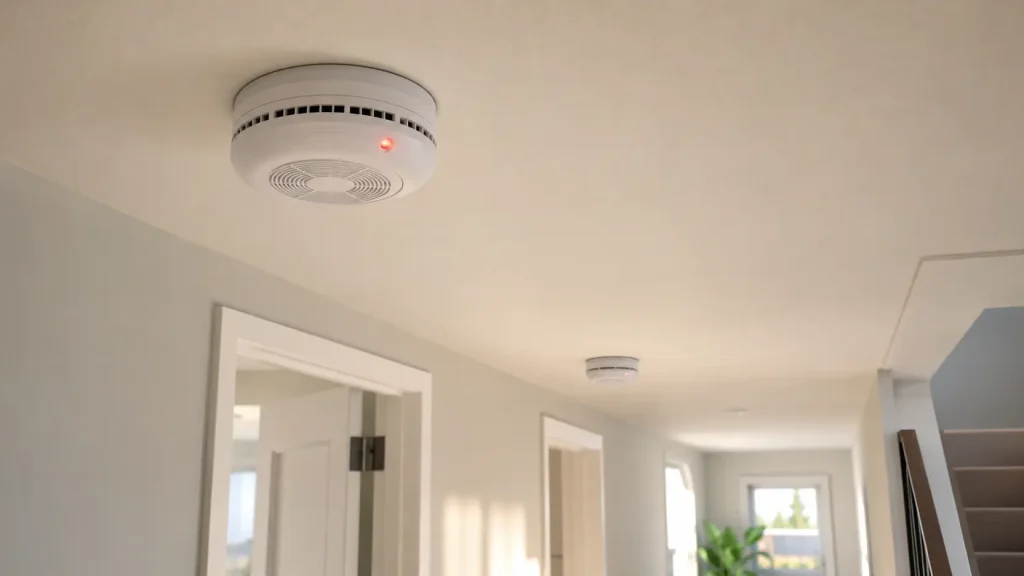
A homeowner walks through the hallway at night and notices a red flash from the ceiling every few seconds. The alarm is silent, there is no visible smoke, and the other units appear normal. A smoke detector blinking red can indicate several different conditions, so the color alone is not enough to decide whether the alarm is working properly.
The safest practical step is to document the complete signal. Note whether the light is steady or flashing, how often it flashes, whether the alarm is chirping or sounding, and which unit in the interconnected system is showing the pattern. Then identify the exact manufacturer and model before interpreting it.
What a smoke detector blinking red may indicate
Smoke-alarm indicators are not standardized into one universal color code for homeowners. A red light can mean active smoke detection on one model, a stored alarm event on another, or normal operation on a different device. Combination smoke and carbon-monoxide alarms can also use distinct light and horn patterns for each hazard.
First Alert’s LED indicator guidance explains that a blinking or steady light without a horn can indicate that certain units are receiving power. Kidde’s guidance for an interconnected nuisance alarm says the initiating unit may flash red or green rapidly while it is in alarm mode. These examples show why advice for one brand or model should not be applied to another.
An active alarm
If the horn is sounding, treat it as a real emergency unless fire officials determine otherwise. Get everyone outside, call 911 from a safe location, and remain outside. Do not remove the battery, disconnect a hardwired unit, or assume the alarm is false because cooking or steam seems like a possible cause.
Alarm memory
Some interconnected alarms identify the unit that originally detected smoke after the horns stop. Kidde notes that certain initiating units continue flashing in a specific pattern after an alarm event. That feature can help identify where smoke, steam, dust, insects, or another condition reached the sensor, but the exact timing must be checked against the correct manual.
Power or standby status
A periodic light can be a normal status signal on some devices. It does not prove the sensor, backup battery, interconnection, and horn are all functioning. The U.S. Fire Administration recommends testing smoke alarms monthly according to the manufacturer’s instructions and replacing the entire alarm every 10 years.
A fault, low battery, or end-of-life signal
Pay attention to the sound as well as the light. A single chirp at a repeating interval, several chirps, or a voice message can communicate different conditions. The pattern may indicate a low backup battery, sensor fault, lost AC power, or end of service life. Replaceable batteries, sealed-battery alarms, and hardwired models require different responses.
If a hardwired alarm begins flashing or chirping unpredictably and the manufacturer’s instructions do not resolve the meaning, call Martin’s Electrical & Lighting Company at (909) 595-1439. A licensed electrician can check the alarm, its power supply, and the interconnected system without disabling required protection.
How to document the pattern safely
Start with observations that do not require removing the alarm. Record the color, flash interval, horn or chirp pattern, and any spoken message. Note whether all alarms sound together during a test and whether the indicator appeared after cooking, a power interruption, a battery change, or an actual alarm.
Photograph the front of the unit and any model information that is visible without detaching it. Save the product manual if it is available. Manufacturer support pages often provide tables that match light and sound patterns to specific operating states.
Do not guess at an unfamiliar signal by disconnecting wires, removing a hardwired alarm from its electrical box, or switching off its circuit for an extended period. Never cover the sensor, remove a backup battery to silence a recurring warning, or replace a hardwired unit with an incompatible model.
Why interconnected alarms need system-level troubleshooting
In a hardwired interconnected system, one initiating alarm can cause every connected alarm to sound. The flashing unit may identify the source, while the other units simply relay the warning. A failure involving the interconnect conductor, AC supply, backup battery, incompatible replacement, or aging alarm can affect how the system responds.
The U.S. Fire Administration recommends interconnected smoke alarms so that when one sounds, they all sound. It also states that only qualified electricians should install hardwired smoke alarms. Martin’s guide to hardwired and battery smoke detectors provides more context about power sources and interconnected protection.
If one alarm was recently replaced, confirm that it is approved for use with the remaining units. Similar-looking plugs and mounting rings do not establish electrical or interconnection compatibility. The manufacturer’s compatibility documentation and applicable local requirements should guide the replacement.
When the electrical system should be checked
Professional diagnosis is appropriate when hardwired alarms lose their normal power indication, chirp after fresh compatible backup batteries are installed, fail to sound together, or behave differently after an outage or electrical work. Repeated breaker trips, heat, discoloration, buzzing, or damaged wiring near an alarm also require attention.
Martin’s electrical troubleshooting service can identify power, connection, circuit, and compatibility problems affecting hardwired safety equipment. When several aging alarms or their wiring need coordinated replacement, professional electrical wiring service helps keep power, backup protection, and interconnection working as a complete system.
Installation and replacement requirements can vary by alarm type, property, project scope, and local jurisdiction. A licensed electrician can confirm the requirements that apply to the address rather than relying on a generic wiring diagram or another home’s configuration.
Do not ignore a new indicator pattern
A silent red flash may be normal for one alarm and important diagnostic information for another. Match the complete light and sound pattern to the exact model, test the unit only as its manufacturer directs, and check the manufacture date. Replace an alarm that has reached its specified service life or fails its prescribed test.
For a smoke detector blinking red, chirping, losing power, or failing to interconnect in San Dimas or the surrounding San Gabriel Valley, call Martin’s Electrical & Lighting Company at (909) 595-1439. Their licensed and insured electricians can evaluate hardwired alarms and related wiring while keeping the home’s fire-safety protection intact.