You are blow-drying your hair, the microwave is running, and suddenly—*click*—everything goes dark. You trudge out to the garage, flip the breaker back on, and go about your day.
But then it happens again the next day. And the next.
A nuisance trip is annoying. A repetitive trip is a warning. Your circuit breaker is a safety device. When it trips, it is doing its job: protecting your house from an electrical fire. Ignoring it or simply resetting it constantly is dangerous.
Here are the 5 most common reasons breakers trip and how to know when you need a professional electrician.
1. The Overloaded Circuit (The Most Common Culprit)
Electricity flows in a specific volume (Amperage). Most standard bedroom or living room circuits are rated for 15 Amps or 20 Amps.
- The Math: W = V x A. A 15-amp circuit at 120 volts can handle roughly 1,800 watts.
- The Overload: A hair dryer uses 1,500 watts. A space heater uses 1,500 watts. A vacuum uses 1,000 watts.
If you run a space heater (1,500W) and plug in a vacuum (1,000W) on the same circuit, you are pulling 2,500 watts. The wire heats up. The breaker senses the heat and trips to stop the wire from melting.
The Fix: Move high-wattage appliances to different circuits. If you constantly trip breakers in the kitchen or garage, you may need to install a dedicated circuit for that specific appliance.
2. A “Short Circuit” (Hard Short)
An overload makes the breaker trip after a few minutes of heat buildup. A short circuit makes it trip instantly with a loud pop or flash.
This happens when a Hot wire (black) touches a Neutral wire (white). The electrical resistance drops to zero, causing a massive surge of current to flow instantly.
- Causes: A loose wire in an outlet, a chewed wire (rodents), or a faulty appliance plug.
The Fix: Unplug everything on the circuit. Reset the breaker. If it trips immediately again, the short is in the wall wiring. Do not try to force it on. Call a professional immediately to trace the short.
3. A Ground Fault
Similar to a short circuit, but the Hot wire touches the Ground wire (bare copper) or the metal side of the outlet box. This energizes things that shouldn’t be energized.
In wet areas (kitchens, baths, outdoors), we install GFCI (Ground Fault Circuit Interrupter) outlets. These trip instantly if they sense electricity going where it shouldn’t (like through water).
The Fix: If a GFCI outlet won’t reset, water might be inside the receptacle, or the device itself has failed.
4. Arc Faults (The Modern Code)
Newer homes in the San Gabriel Valley are required to have AFCI (Arc Fault Circuit Interrupter) breakers. These are highly sensitive smart breakers.
They listen for the “signature” of electricity arcing (jumping) across a loose connection or a frayed cord.
- Nuisance Tripping: Early AFCI breakers were sensitive and would trip from vacuum motors. However, modern AFCIs are reliable. If an AFCI trips, it usually means you have a loose wire connection in an outlet somewhere that is sparking silently.
The Fix: This requires electrical troubleshooting to find the loose connection before it starts a fire.
5. A Faulty or Old Breaker
Breakers are mechanical switches. They have springs and contacts inside. Over time (30+ years), they get weak or “soft.”
A soft breaker might trip at 10 amps even though it is rated for 20 amps. It reacts too quickly to minor fluctuations. Alternatively, it might corrode and fail to transmit power efficiently.
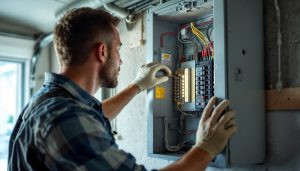
The Fix: If you have balanced the load and checked for shorts, but the breaker still trips, the breaker itself likely needs replacement. Note: Replacing a breaker involves working inside a live panel. This is not a DIY job.
Summary: Listen to Your Breaker
If a breaker trips once, it’s a fluke. If it trips twice, it’s a coincidence. If it trips three times, it’s a pattern.
At Martin’s Electrical, we use specialized circuit tracers and load testers to diagnose exactly *why* your system is failing. Whether you need a simple breaker swap or a complete panel upgrade, we ensure your power stays on safely.
Get a free estimate for troubleshooting your tricky electrical issues.