Summer in the San Gabriel Valley is predictable: intense heat during the day (95°F+) followed by a beautifully cool evening (65°F).
Most homeowners run their Air Conditioning until 10:00 PM trying to cool the house down for sleep. This is expensive. The AC compressor is the single largest energy consumer in your home.
There is a smarter way to cool your home that costs pennies on the dollar compared to AC: The Whole House Fan.
How a Whole House Fan Works
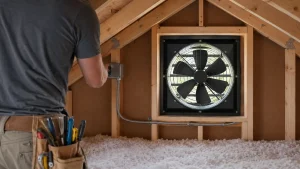
A Whole House Fan is a massive exhaust fan installed in the ceiling of your central hallway or landing. It vents into the attic.
Unlike a ceiling fan (which just moves air around a room), a Whole House Fan actively exchanges the air in the entire building.
The Process:
1. In the evening, when the outside air drops below the inside temperature (usually around 7:00 PM), you open a few windows.
2. You turn on the fan.
3. The fan pulls cooler fresh air in through the open windows.
4. It sucks the hot, stale air out of the living space and blasts it into the attic.
5. This positive pressure pushes the super-heated air out of your attic vents.
The Cooling Effect: Thermal Mass
It doesn’t just cool the air; it cools the *house*.
During the day, your walls, furniture, and attic insulation absorb heat. Even if the air is 75°F, your walls might be radiate heat at 85°F.
A Whole House Fan runs at high volume (1,500 to 7,000 CFM – Cubic Feet per Minute). By cycling fresh cool air through the house 15-20 times per hour, it draws the heat out of the walls and furniture (Thermal Mass Cooling).
- Result: The house stays cool well into the next day because the structure itself was chilled overnight.
The Cost Savings
Running a central AC unit typically uses 3,000 to 5,000 watts of electricity.
Running a modern QuietCool whole house fan uses 200 to 500 watts.
It is 90% cheaper to run.
If you can turn off your AC at 7:00 PM and switch to the fan, you save 3-4 hours of peak-time AC usage every single day. For many SGV homeowners, this pays for the fan installation in 2-3 summers.
Old vs. New: The Noise Factor
You might remember old “helicopter” fans from the 1980s that sounded like a jet engine in the hallway.
We install modern QuietCool systems.
- Suspended Motor: The motor hangs in the attic, suspended by straps, rather than bolted to the ceiling joists. This eliminates vibration noise.
- Insulated Duct: A localized duct connects the ceiling grille to the fan motor, muffling the sound.
You can watch TV or sleep with these fans running.
Installation Requirements
Not every home is ready for a fan.
1. Attic Ventilation: You must have enough roof vents (dormers, ridge vents, or gable vents) to let the air escape. If you pump air into the attic and it can’t get out, you will pressurize the house and push dust back down.
2. Ceiling Space: We need a clear spot in the hallway free of lights, smoke detectors, and HVAC ducts.
Martin’s Electrical specializes in ceiling fan and whole house fan installation. We calculate the exact CFM needed for your square footage and ensure your attic venting matches the fan’s output.
Stop Burning Money on AC
Take advantage of our California climate. We have free cool air every night—why pay to manufacture cold air?
Contact us to see if a Whole House Fan is right for your home.