Power outages in the San Gabriel Valley are not rare events. Between aging grid infrastructure, Public Safety Power Shutoffs (PSPS) during high fire-risk conditions, summer heat overloading transformers, and occasional severe weather, most SGV homeowners experience multiple outages per year. Some last hours. Others last days.
A whole home generator eliminates the disruption entirely. When grid power drops, an automatic transfer switch detects the outage and starts the generator within seconds. Your lights stay on, your refrigerator keeps running, your HVAC continues operating, and your home functions normally while neighbors sit in the dark.
But whole home generators represent a significant investment — anywhere from $7,000 to $25,000+ installed depending on size, fuel type, and site requirements. Understanding what you actually need, what drives costs, and how the installation process works helps you make a decision that matches your household’s requirements without overspending.
Generator Sizing: How Much Power Do You Actually Need?
The most critical decision in generator selection is sizing. An undersized generator cannot power your essential systems simultaneously. An oversized generator wastes money upfront and burns fuel inefficiently.
How generators are sized: Generators are rated in kilowatts (kW). A 10kW generator produces 10,000 watts continuously. Your home’s electrical load varies moment to moment depending on what is running.
Typical loads for San Gabriel Valley homes:
– Central AC (3-5 ton): 3,500 to 6,000 watts running, 8,000 to 15,000 watts startup surge
– Refrigerator: 100 to 400 watts running
– Electric range/oven: 2,000 to 5,000 watts
– Lighting (whole house): 500 to 2,000 watts
– Well pump (if applicable): 1,000 to 2,000 watts
– Pool pump: 1,500 to 2,500 watts
– EV charger (Level 2): 7,200 to 9,600 watts
– Sump pump: 500 to 1,500 watts
– Electronics, internet, security: 200 to 500 watts
Sizing recommendations by home profile:
– Essential circuits only (lights, fridge, internet, some outlets): 10-14 kW
– Full house coverage without AC: 14-18 kW
– Full house with central AC: 18-24 kW
– Large home with AC, pool, and EV charger: 24-48 kW
Most San Gabriel Valley homes with central AC and standard appliances need a 20-24 kW generator for comfortable whole-home coverage. If you are willing to manage loads (not running AC and oven simultaneously during an outage), a 16-18 kW unit may suffice at lower cost.
Your electrician performs a load calculation based on your actual panel circuits and appliance ratings to determine the right size. This is not a guessing exercise — it is a documented calculation that ensures the generator matches your home’s specific electrical demands.
Cost Breakdown by System Size
Generator unit cost (equipment only):
– 10-14 kW: $3,500 to $5,500
– 16-20 kW: $5,000 to $8,000
– 22-24 kW: $6,500 to $10,000
– 30-48 kW: $10,000 to $18,000
Installation labor and materials:
– Standard installation: $3,000 to $6,000
– Complex installation (long gas runs, panel modifications, concrete pad): $5,000 to $10,000
Total installed cost ranges:
– Economy (14 kW, essential circuits): $7,000 to $11,000
– Mid-range (20-22 kW, whole house): $10,000 to $16,000
– Premium (24-48 kW, large homes): $15,000 to $25,000+
What installation includes:
– Concrete or composite mounting pad
– Gas line connection (natural gas or propane tank setup)
– Automatic transfer switch installation at main electrical panel
– Generator wiring and connection
– Permits and inspections
– System commissioning and testing
– Homeowner orientation
What is typically excluded:
– Gas line extension if generator is far from existing gas supply (gas plumber handles this separately)
– Extended propane tank installation for propane units
– Tree removal or significant landscaping to clear the installation area
– Panel upgrade if current panel lacks space for transfer switch
Natural Gas vs. Propane: Which Fuel Type
San Gabriel Valley homes overwhelmingly have natural gas service, making natural gas generators the most convenient choice for most homeowners. But each fuel type has distinct advantages.
Natural gas generators:
– Unlimited fuel supply (connected to utility gas line)
– No fuel storage on property
– Slightly lower generator cost for same kW rating
– Fuel cost: approximately $1.50 to $2.00 per hour at 50% load for a 20 kW unit
– Consideration: natural gas supply can be interrupted during earthquakes or major disasters
Propane generators:
– Independent of utility infrastructure (works even if gas lines are damaged)
– Requires on-site propane tank (250-1000 gallon, depending on desired run time)
– Higher equipment cost for same kW rating
– Fuel cost: approximately $2.50 to $3.50 per hour at 50% load for a 20 kW unit
– Tank requires periodic refilling (monitor gauge)
– Better cold-weather starting than natural gas
Recommendation for most SGV homes: Natural gas is the practical choice. The gas grid in the San Gabriel Valley is reliable, fuel is always available, and the cost-per-hour is lower. Propane is the right call for rural properties without natural gas service, homes in high fire-risk zones where gas shutoffs are frequent, or homeowners who want grid-independent backup without any utility dependency.
The Installation Process Step by Step
Generator installation involves coordination between your electrician, a gas plumber (for the fuel connection), and your local building department (for permits and inspection). Here is the typical timeline:
Week 1-2: Site assessment and equipment selection. Your electrician evaluates your panel, performs a load calculation, identifies the optimal generator placement location (considering setback requirements, noise, exhaust direction, and fuel access), and recommends a specific unit. You select and order the generator.
Week 2-4: Equipment arrival and permitting. Generators are not always in stock — ordering may take one to three weeks depending on model and demand. During this time, your electrician pulls the electrical permit and the gas plumber pulls the mechanical permit.
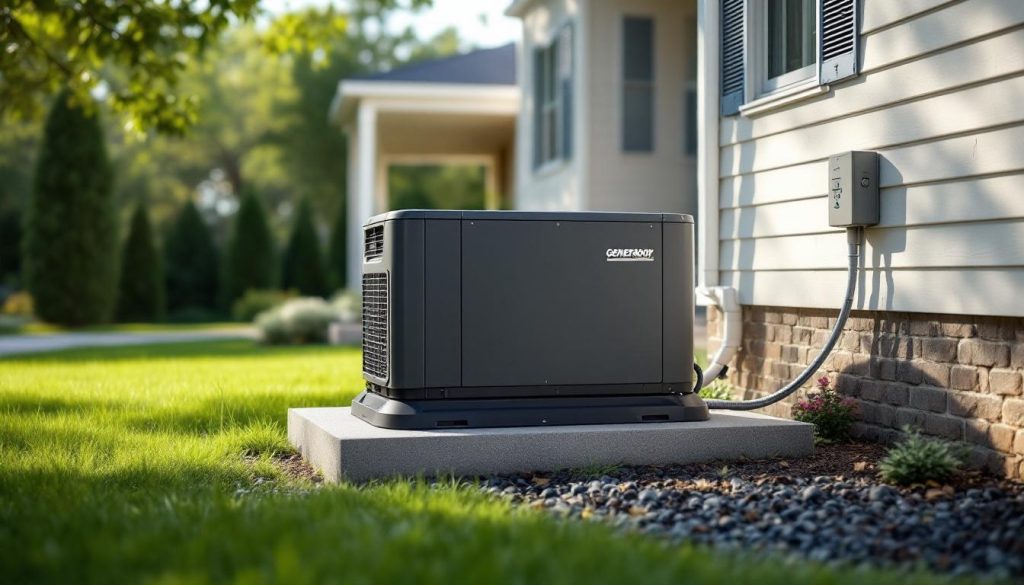
Installation day 1: Pad and generator placement. A level concrete pad or composite mounting platform is prepared. The generator is placed and secured. In most cases, a crane or equipment is needed for larger units (500+ pounds).
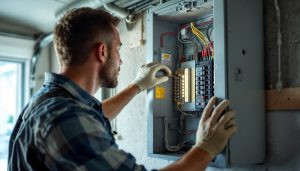
Installation day 2: Electrical connection. Your electrician installs the automatic transfer switch (adjacent to your main panel), runs conduit and wire from the transfer switch to the generator, and makes all electrical connections. The transfer switch is the device that monitors grid power and automatically switches to generator power during outages.
Installation day 2-3: Gas connection. A licensed gas plumber runs a dedicated gas line from your meter to the generator location, sized appropriately for the generator’s BTU demand. This includes a manual shutoff valve at the generator and a sediment trap per code.
Final: Inspection and commissioning. The building inspector verifies all work meets code — setbacks, electrical connections, gas piping, and ventilation clearances. After passing inspection, the system is commissioned: the electrician simulates a power outage, confirms the generator starts within 10-30 seconds, all circuits transfer properly, and the system returns to grid power seamlessly when utility service is restored.
Placement Requirements and Local Code
Generator placement is governed by manufacturer specifications and local building codes. In San Gabriel Valley cities, typical requirements include:
– Minimum 5 feet from any window, door, or air intake
– Minimum 3 feet from property line (varies by city — verify with your building department)
– Minimum 18 inches of clearance on service-access sides
– Exhaust directed away from living spaces and neighboring windows
– Sound level compliance (most modern generators run 65-70 dB at rated load — similar to a normal conversation from 20 feet away)
– Flood zone elevation requirements if applicable
The ideal placement balances code compliance, proximity to both the electrical panel and gas supply (shorter runs = lower cost), access for maintenance, and noise considerations relative to your bedrooms and your neighbor’s windows.
Maintenance and Long-Term Costs
A whole home generator is a mechanical system that requires regular maintenance to remain reliable. Most manufacturers recommend:
– Weekly automatic self-test cycle (programmed during commissioning — the generator starts itself briefly each week)
– Oil and filter change every 100-200 hours of runtime or annually
– Air filter inspection and replacement annually
– Spark plug replacement every 400-600 hours (natural gas units)
– Battery replacement every 2-3 years
– Annual professional service inspection: $200 to $400
Fuel cost during outages depends on your generator size, load, and local gas rates. A 20 kW natural gas generator running at 50% load costs roughly $1.50 to $2.50 per hour in fuel in the Los Angeles service area. During a 24-hour outage, expect $36 to $60 in fuel cost — far less than the cost of spoiled food, hotel stays, or business interruption.
Is a Whole Home Generator Worth It?
The financial case for a generator depends on how much outages cost you personally. For households with medical equipment that requires power, home-based businesses that lose revenue during outages, expensive refrigerated medications, or simply a low tolerance for disruption, the generator pays for itself in peace of mind and avoided costs.
From a property value perspective, whole home generators add approximately 50-75% of their installed cost to home resale value in desirable markets. For SGV homes in the $800K+ range, a $15,000 generator installation is a modest percentage of home value and a strong selling point.
The decision often comes down to whether you view power outages as an inconvenience you can tolerate or a disruption that costs you real money, comfort, and safety. For households with elderly family members, young children, home medical equipment, refrigerated medications, or work-from-home income dependence, the calculation overwhelmingly favors installation.
For homeowners who simply want assurance that the next PSPS event or summer grid failure will not disrupt their household, a properly sized generator provides decades of reliable backup at a cost that typically represents less than two percent of the home’s value.
Ready to discuss generator options for your San Gabriel Valley home? Get a free estimate and we will calculate your specific load requirements, recommend the right size, and provide an exact installed price.