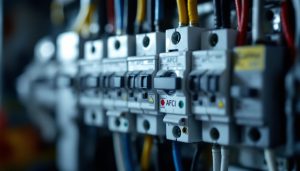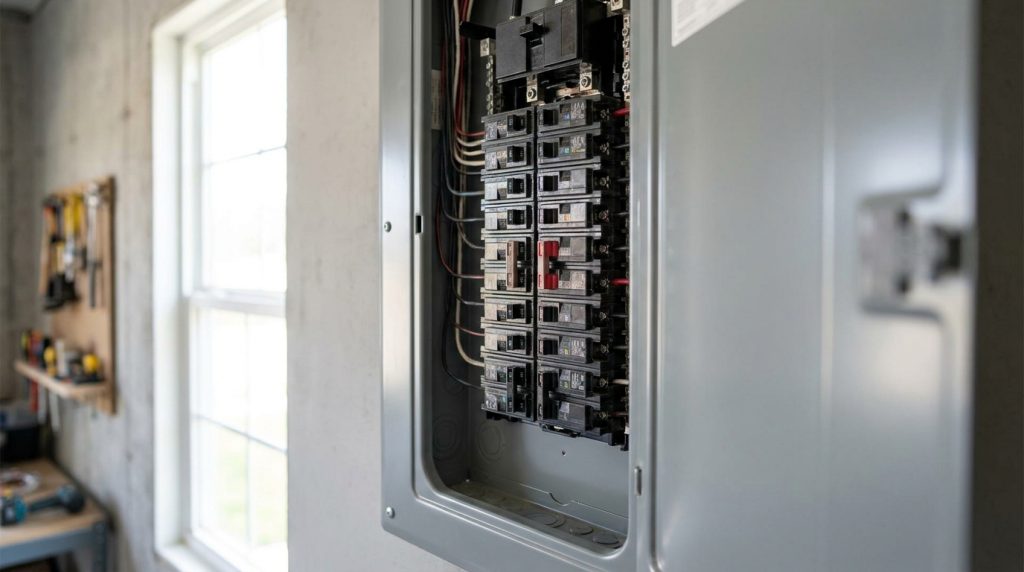
AFCI (Arc-Fault Circuit Interrupter) breakers detect dangerous electrical arcs and shut off power to prevent fires, while CAFCI (Combination Arc-Fault Circuit Interrupter) breakers provide broader protection by detecting both series and parallel arc faults. Most homes built or remodeled after 2008 require CAFCI breakers in specific rooms, and understanding the difference helps homeowners make informed decisions about electrical safety.
AFCI vs CAFCI at a Glance
Here is how the two compare at a glance:
- Standard AFCI breakers primarily detect parallel arc faults, use basic arc recognition, and were the norm under pre-2008 code cycles. You’ll mostly find them in older electrical panels, and they’re considered outdated for new work today.
- CAFCI (Combination AFCI) breakers detect both series and parallel arc faults using more advanced waveform analysis. They became the standard with the 2008 NEC and later cycles, and are now the current residential standard for bedrooms and living areas.
CAFCI breakers represent the current standard for residential electrical protection. They combine the earlier parallel arc-fault detection with series arc-fault detection, offering comprehensive protection against the electrical conditions that cause fires in homes.
What an AFCI Breaker Actually Does
Arc-fault breakers protect homes from electrical fires caused by damaged, deteriorating, or improperly installed wiring. An electrical arc is an ongoing discharge of electricity across a gap, similar to a continuous spark. When wiring insulation breaks down or connections loosen, arcs can generate intense heat—enough to ignite nearby wood framing, insulation, or other combustible materials.
There are two types of dangerous arcs:
Parallel arcs occur between two conductors—hot to neutral or hot to ground. These happen when wires touch after insulation damage, creating a direct path between conductors. A nail driven through a cable, rodent damage, or deteriorated insulation can create parallel arc conditions.
Series arcs occur along a single conductor when there’s a break or poor connection in the circuit. Loose wire connections at outlets, switches, or fixtures create series arcs. So do damaged cords on lamps and appliances. Series arcs are particularly dangerous because they’re harder to detect with traditional circuit breakers, which primarily respond to overloads and short circuits.
Standard AFCI breakers, introduced in the late 1990s, focused mainly on parallel arc faults. They represented a significant safety improvement, but electrical fires continued to occur from series arc faults that went undetected.
What CAFCI (Combination AFCI) Means and How It Differs
CAFCI breakers detect both parallel and series arc faults, providing complete protection against arc-related fire hazards. The “combination” refers to combining two detection technologies in a single device—one for parallel arcs and one for series arcs.
How CAFCI breakers work:
- Continuously monitor the electrical waveform on the circuit
- Analyze current patterns to distinguish dangerous arcs from normal operation
- Recognize arc signatures that indicate deteriorating connections or damaged wiring
- Trip the circuit in milliseconds when dangerous arc patterns are detected
- Ignore harmless arcing from motor brushes, light switches, and normal household devices
CAFCI technology uses sophisticated electronics to differentiate between the sharp, irregular waveforms of dangerous arcs and the predictable patterns of devices like vacuum cleaners, power tools, and dimmer switches that create brief, harmless arcs during normal operation.
Starting with the 2008 National Electrical Code, CAFCI breakers became the standard for bedroom circuits. Subsequent code cycles expanded the requirement to most living areas. Homes in Glendora, San Dimas, La Verne, and throughout the San Gabriel Valley that were built or substantially remodeled after these dates typically have CAFCI breakers protecting bedrooms, living rooms, dining rooms, and other habitable spaces.
Why “Combination” Does NOT Mean AFCI + GFCI
A common point of confusion: CAFCI breakers combine two *types* of arc-fault detection (series and parallel), not arc-fault and ground-fault protection. The name refers to the combination of protection methods against different arc faults.
GFCI (Ground-Fault Circuit Interrupter) protection is an entirely separate safety feature that detects current leakage to ground—the type of electrical fault that causes shock hazards in wet locations. You need both types of protection in your home, but they serve different purposes:
- CAFCI breakers prevent fires from electrical arcs
- GFCI devices prevent shock in bathrooms, kitchens, garages, and outdoor areas
Some newer breakers combine both technologies in a single device (often called dual-function or AFCI/GFCI breakers), but standard CAFCI breakers provide only arc-fault protection. Understanding the difference between AFCI vs GFCI protection helps homeowners ensure they have the right devices in the right locations.
AFCI vs GFCI vs CAFCI: Clearing Up the Confusion
The acronyms sound similar, but these devices protect against different electrical hazards:
AFCI (Arc-Fault Circuit Interrupter):
- Detects parallel arc faults
- Earlier technology, pre-2008 standard
- Basic arc detection
CAFCI (Combination Arc-Fault Circuit Interrupter):
- Detects both series and parallel arc faults
- Current standard for living areas
- Advanced arc detection and analysis
GFCI (Ground-Fault Circuit Interrupter):
- Detects current leakage to ground
- Prevents shock in wet or outdoor locations
- Required in bathrooms, kitchens, garages, outdoors
- Different purpose than arc-fault protection
A properly protected modern home has CAFCI breakers on bedroom and living area circuits, GFCI protection in wet locations, and standard breakers on dedicated appliance circuits where appropriate. Some circuits may require dual-function breakers that provide both CAFCI and GFCI protection.
Why Your Arc-Fault Breaker Keeps Tripping
CAFCI breakers occasionally trip in homes where older AFCI breakers never did. This happens because CAFCI breakers detect a broader range of fault conditions—which is exactly what they’re designed to do. However, nuisance tripping can also occur.
Common causes of CAFCI breaker trips:
Actual arc faults (real hazards):
- Loose wire connections at outlets or switches
- Damaged extension cords or appliance cords
- Deteriorating wire insulation in walls
- Improper wire splices in junction boxes
- Rodent damage to cables
Nuisance trips (false positives):
- Older vacuum cleaners with worn motor brushes
- Some power tools and shop equipment
- Certain electronic devices with switching power supplies
- Incompatibility between particular devices and specific breaker brands
If your circuit breaker that keeps tripping is a CAFCI breaker, do not simply replace it with a standard breaker to eliminate the trips. The CAFCI may be detecting a real problem that poses a fire risk. A licensed electrician can test the circuit to determine whether trips indicate an actual arc fault that needs repair or a nuisance trip that might be resolved by replacing a worn appliance cord or trying a different breaker brand.
Which Breaker Does Your Home Need?
The answer depends on when your home was built, which rooms are involved, and what work you’re doing.
For new construction or major remodels:
Current electrical code generally requires CAFCI protection for most living area circuits, including bedrooms, living rooms, dining rooms, family rooms, dens, libraries, sunrooms, closets, and hallways. Your local building jurisdiction and the specific circumstances determine the exact requirements.
For existing homes:
Homeowners are not typically required to upgrade to CAFCI breakers unless they’re performing electrical work that triggers permit requirements. However, many homeowners in Covina, Glendora, and throughout Los Angeles County choose to upgrade when replacing older panels or when adding circuits during remodels. Understanding why California requires AFCI breakers helps inform these decisions.
For panel replacements:
When replacing an older electrical panel with a panel upgrade, current code generally requires CAFCI breakers for applicable circuits. This adds to the project cost compared to a simple panel swap, but provides substantial fire safety improvements. A licensed electrician can evaluate your specific situation and explain which circuits require CAFCI protection under current code.
For DIY replacement caution:
CAFCI breakers are not universal. Different manufacturers use different detection algorithms, and what works well in one panel may cause nuisance tripping in another. Professional electricians test circuits after installing CAFCI breakers to ensure they function properly without false trips.
When to Call a Licensed Electrician
Certain situations require professional evaluation and installation:
You should contact a licensed electrician when:
- A CAFCI or AFCI breaker trips repeatedly, which may indicate dangerous wiring conditions
- You’re upgrading an older electrical panel and need to determine CAFCI requirements
- You’re planning a room addition or remodel requiring new circuits
- You have frequent electrical issues suggesting wiring problems
- Your home was built before 2008 and you want to improve electrical safety
- You need to determine whether existing older AFCI breakers should be upgraded to CAFCI
Arc-fault breakers provide measurable fire safety benefits, but they must be properly specified, installed, and tested. Incorrect installation can lead to nuisance tripping or, worse, failure to provide protection. Professional electricians have the tools to test circuits for arc faults, verify breaker operation, and ensure installations meet code requirements without creating false-trip problems.
An experienced electrical contractor can evaluate your arc-fault protection needs, recommend the right breakers for your panel, and install them so they provide reliable protection without constant nuisance trips.
If you’re experiencing issues with arc-fault breakers or need professional guidance on electrical panel upgrades and circuit protection, Martin’s Electrical & Lighting provides expert diagnosis and code-compliant installations throughout greater Los Angeles. Call (909) 595-1439 or visit our website for a free estimate.