Understanding AFCI breaker requirements is essential for homeowners in San Gabriel Valley, especially those with older electrical systems. Arc-fault circuit interrupters represent a significant advancement in electrical fire prevention, and California’s adoption of the latest National Electrical Code has made them mandatory in most living spaces. These specialized breakers detect dangerous electrical arcing that standard circuit breakers miss, shutting off power before a fire can start. For homeowners in San Dimas, Glendora, La Verne, and Covina, AFCI protection is no longer optional—it’s required by code for new construction, major remodels, and certain electrical upgrades. Many older homes in the area lack this protection entirely, leaving families vulnerable to electrical fires caused by damaged wiring, loose connections, or aging electrical systems.
What Is an Arc-Fault Circuit Interrupter (AFCI)?
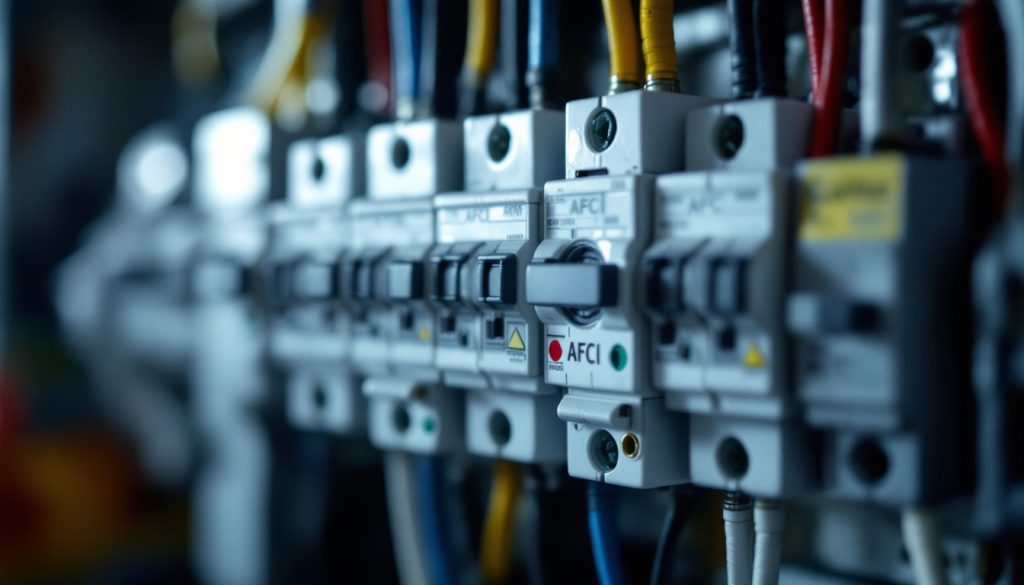
An arc-fault circuit interrupter is a specialized circuit breaker designed to detect and stop dangerous electrical arcing before it causes a fire. Unlike standard breakers that only respond to overloads and short circuits, AFCI breakers use advanced sensors to identify the unique electrical signature of arcing faults. These devices monitor the electrical waveform on the circuit, looking for the irregular patterns that indicate arcing.
Arcing occurs when electricity jumps across a gap in the circuit, creating extreme heat that can ignite nearby materials. There are two types of dangerous arcing that AFCI breakers detect: parallel arcing and series arcing. Parallel arcing happens when electricity arcs between the hot and neutral wires, often caused by damaged insulation or a nail driven through a wire. Series arcing occurs when there’s a break in a single wire, causing electricity to jump the gap—this commonly happens at loose wire connections, frayed cords, or damaged outlets.
Standard circuit breakers cannot detect these arcing faults because they don’t draw excessive current. The arcing might only use a few amps, well below the breaker’s trip threshold, yet still generate enough heat to ignite wood framing, insulation, or other combustible materials. AFCI breakers fill this critical safety gap by identifying the electrical signature of arcing and disconnecting power within milliseconds.
AFCI vs GFCI: Understanding the Difference
While both AFCI and GFCI breakers provide advanced electrical protection, they serve completely different purposes and protect against different hazards. Understanding the distinction helps homeowners know which protection they need and where.
GFCI breakers—ground-fault circuit interrupters—protect people from electrical shock. They monitor the current flowing through the hot and neutral wires, tripping instantly if they detect an imbalance as small as 4-6 milliamps. This imbalance indicates that electricity is taking an unintended path, potentially through a person’s body. GFCI protection is required in areas where water and electricity might meet: bathrooms, kitchens, outdoor outlets, garages, and laundry rooms.
AFCI breakers protect property from fire rather than people from shock. They detect the electrical signature of arcing faults—those dangerous sparks that occur inside walls, at connections, or in damaged cords. AFCI protection is required in living spaces like bedrooms, living rooms, dining rooms, and family rooms. Some circuits require both protections: kitchen small appliance circuits, for example, need GFCI protection against shock hazards and AFCI protection against fire hazards. Modern combination AFCI/GFCI breakers provide both protections in a single device.
The key distinction is the threat each device addresses. GFCI prevents electrocution from ground faults. AFCI prevents fires from arcing faults. Neither can substitute for the other, which is why electrical panel services in San Dimas often include installing both types of protection to bring older homes up to current safety standards.
Where AFCI Breakers Are Required: NEC 2020+ Standards
AFCI breaker California requirements have expanded significantly with each code cycle, and the current NEC 2020 standards adopted by California require arc fault protection in nearly all living spaces. The requirements apply to 120-volt, 15- and 20-amp branch circuits supplying outlets and devices in specific areas.
AFCI protection is now required in family rooms, dining rooms, living rooms, parlors, libraries, dens, bedrooms, sunrooms, recreation rooms, closets, hallways, laundry areas, and similar rooms or areas. Kitchens also require AFCI protection, typically with combination AFCI/GFCI breakers to address both fire and shock hazards. This requirement covers nearly every room where people spend time, with limited exceptions for bathrooms, garages, unfinished basements, and outdoor circuits—though these areas still require GFCI protection.
The NEC AFCI requirements mean that a typical home needs AFCI protection on 10 to 20 circuits, depending on the home’s size and electrical layout. Older San Gabriel Valley homes built before 2008 typically have zero AFCI breakers installed, as earlier code cycles only required them in bedrooms. This leaves significant gaps in fire protection for most existing homes in San Dimas, Glendora, and surrounding communities.
The requirements become mandatory when work requires a permit—new construction, room additions, major remodels, or panel replacements all trigger the obligation to bring affected circuits up to current AFCI standards.
How AFCI Breakers Prevent Electrical Fires
Arc fault protection addresses one of the most common and dangerous causes of residential fires. According to the U.S. Fire Administration, electrical failures or malfunctions cause an estimated 24,000 residential fires annually, and many of these originate from arcing faults that standard breakers cannot detect.
The fire prevention mechanism works through continuous monitoring of the circuit’s electrical waveform. The AFCI’s microprocessor analyzes the current signature thousands of times per second, looking for the distinctive patterns that indicate arcing. Normal electrical loads—motors, dimmers, switches—create predictable waveforms that the AFCI recognizes as safe. Dangerous arcing creates a chaotic, high-frequency signature that’s distinctly different from normal operation. When the AFCI detects this signature, it trips the breaker within milliseconds, long before the arc can generate enough heat to ignite wood, insulation, or other combustible materials.
This protection is particularly valuable in older homes where wiring insulation may be deteriorating, connections may have loosened over decades of thermal cycling, and modifications may have compromised the original installation. Many San Gabriel Valley homes date to the 1950s through 1980s, when aluminum wiring was common and electrical standards were less stringent. These homes face higher fire risks from electrical problems in old houses, making AFCI protection especially important.
Beyond deteriorating infrastructure, AFCI breakers protect against common hazards like furniture damaging cords, picture hangers driven through wires in walls, and rodent damage to wiring in attics or walls.
Common Causes of Nuisance Tripping and Solutions
Nuisance tripping AFCI breakers frustrate many homeowners, particularly when the breaker trips repeatedly without any apparent electrical problem. Understanding what causes false trips and how to address them helps distinguish between legitimate protection and issues that need troubleshooting.
The most common cause of nuisance trips is incompatibility with specific electrical devices. Older power tools, vacuum cleaners with brush motors, treadmills, and some fluorescent lighting can create electrical signatures that early-generation AFCI breakers mistake for dangerous arcing. Newer AFCI breakers—particularly those manufactured after 2014—use more sophisticated algorithms that better distinguish between normal motor operation and dangerous arcing, significantly reducing false trips.
Another frequent culprit is shared neutral wiring, a configuration common in older homes where one neutral wire serves two circuits. AFCI breakers don’t work correctly with shared neutrals and will trip intermittently when loads on the paired circuits operate simultaneously. Properly separating the circuits and providing dedicated neutrals eliminates this problem. This issue often comes up when looking at circuit breakers tripping with nothing plugged in.
Compromised wiring or poor connections can also cause AFCI trips. While this indicates the AFCI is doing its job, the solution requires finding and repairing the fault. Loose connections, damaged insulation, or improper splices all create exactly the type of hazard AFCI breakers are designed to detect.
Cost to Upgrade to AFCI Breakers in San Gabriel Valley
The AFCI breaker cost involves both the devices themselves and the labor required for proper installation and testing. Understanding the complete cost helps San Gabriel Valley homeowners budget for electrical safety upgrades.
Individual AFCI breakers typically range from $40 to $80 each, depending on the manufacturer, amperage, and whether they include combination AFCI/GFCI protection. For a standard electrical panel requiring 10 to 15 AFCI breakers, material costs alone run $500 to $1,200.
Professional installation labor adds to the material cost. A licensed electrician charges $100 to $150 per hour in the San Gabriel Valley, and installing AFCI breakers requires more than simply swapping devices. The electrician must verify proper neutral-to-ground separation, ensure circuits don’t have shared neutrals, test each AFCI’s functionality, and confirm compatibility. A complete AFCI upgrade typically takes 3 to 5 hours, bringing labor costs to $300 to $750. Total project costs typically range from $800 to $2,000.
Some situations increase costs. Very old panels may lack the neutral bus configuration required for AFCI breakers, necessitating panel replacement. Panels from defunct manufacturers or panels subject to recalls require complete replacement, raising costs to $2,000 to $4,000.
AFCI Requirements During Remodels and Permit Work
AFCI requirements become mandatory for San Gabriel Valley homeowners when electrical work requires a permit, triggering obligations to bring affected circuits—and sometimes the entire electrical system—up to current code standards.
Any work that requires an electrical permit generally triggers AFCI requirements for the circuits involved. Room additions, kitchen remodels, bedroom conversions, and major renovations all require AFCI protection on new or modified circuits. Minor modifications—replacing outlets or fixtures on existing circuits—typically don’t require upgrading the circuit to AFCI. Major work—adding circuits, reconfiguring rooms, or replacing panels—does require AFCI compliance.
Electrical panel replacement or upgrades always trigger comprehensive AFCI requirements. When replacing a panel, current code requires AFCI protection on all applicable circuits, not just new ones. This means a panel upgrade in a 1960s-era home might require installing 15 to 20 AFCI breakers to bring the entire electrical system into compliance.
Kitchen and bathroom remodels present particular complexity because they require both AFCI and GFCI protection. Combination AFCI/GFCI breakers provide both protections, satisfying code requirements while simplifying the installation.
Building inspectors in Los Angeles County strictly enforce AFCI requirements. Projects that don’t include required AFCI protection will fail inspection, delaying completion and requiring rework. Working with knowledgeable electrical repair and troubleshooting professionals ensures that AFCI requirements are anticipated during planning, properly included in estimates, and correctly implemented during installation.
Protecting Your Home with Modern Electrical Safety
AFCI breaker requirements reflect decades of research into residential fire prevention and represent proven technology for reducing electrical fire risk. For San Gabriel Valley homeowners, understanding these requirements helps with planning remodels, budgeting for electrical upgrades, and making informed decisions about home safety.
The investment in AFCI protection—typically $800 to $2,000 for a whole-home upgrade—provides substantial value through reduced fire risk, code compliance, and peace of mind. Modern AFCI technology has matured significantly from early implementations, offering reliable protection with minimal nuisance tripping when properly installed and matched to the electrical system.
Whether you’re planning a major remodel, addressing specific electrical concerns, or proactively upgrading your home’s safety systems, professional guidance ensures AFCI breakers are correctly specified, properly installed, and thoroughly tested. The right approach considers your home’s age, electrical system configuration, and specific safety needs while ensuring full compliance with California’s electrical code requirements.
Martin’s Electrical & Lighting Company provides comprehensive electrical panel services throughout the San Gabriel Valley, including AFCI breaker installation, electrical safety evaluations, and code compliance upgrades. Our licensed electricians have extensive experience with both modern and historic electrical systems in the area and can recommend the right approach for your home’s specific situation. Get a free estimate today to learn how AFCI protection can improve your home’s electrical safety and bring your system up to current standards.