A San Dimas homeowner may notice the second floor staying warm long after sunset, even while the air conditioner keeps running. The attic above it can hold a large amount of heat, but adding a powered fan is not automatically the right answer. Effective attic fan installation starts with the attic itself: its existing vents, insulation, air sealing, roof design, and electrical access.
An attic fan can be useful when it is correctly selected and installed as part of a complete ventilation strategy. A fan that is oversized, poorly controlled, or starved for intake air may deliver disappointing results. The practical takeaway is simple: evaluate airflow and electrical conditions together before choosing equipment.
What Attic Fan Installation Actually Does
A powered attic fan removes hot air from the attic and replaces it with outdoor air entering through intake vents. It is intended to manage conditions in the attic, not blow air through occupied rooms. Martin’s provides attic and gable fan installation along with other residential fan services throughout Southern California.
This is different from a whole-house fan. A whole-house system draws cooler outdoor air through open windows, moves that air through the living space, and exhausts it into the attic. Homeowners comparing the two can review Martin’s whole-house fan installation guide. The systems serve different areas and require different operating habits.
The goal is balanced ventilation
A powered attic ventilator needs a dependable path for replacement air. The Home Ventilating Institute emphasizes adequate intake vent area for proper fan operation. Without it, the fan may pull from unintended gaps rather than moving outdoor air through the attic as designed.
That is why the fan cannot be sized from attic square footage alone. A useful evaluation considers net free vent area, roof and gable vent locations, attic layout, obstructions, and the fan manufacturer’s requirements. If those pieces do not work together, more fan capacity is not necessarily better.
When an Attic Fan May Be Worth Considering
Attic fan installation may make sense when an attic experiences persistent heat buildup and already has, or can be given, adequate intake ventilation. It can also be appropriate when an existing fan has failed, a gable opening is suitable for a properly sized unit, or a homeowner wants automatic temperature-based attic ventilation.
The decision should still account for insulation and air sealing. A fan does not replace damaged insulation, blocked soffit vents, or gaps that allow conditioned indoor air to leak into the attic. In some homes, correcting those conditions should come first. In others, the best result comes from combining building-envelope improvements with a properly designed powered ventilator.
If you are unsure whether the attic needs a new fan, improved venting, or an electrical repair, call (909) 595-1439 to discuss an attic fan installation evaluation with Martin’s Electrical & Lighting Company.
The Electrical Details Matter as Much as Airflow
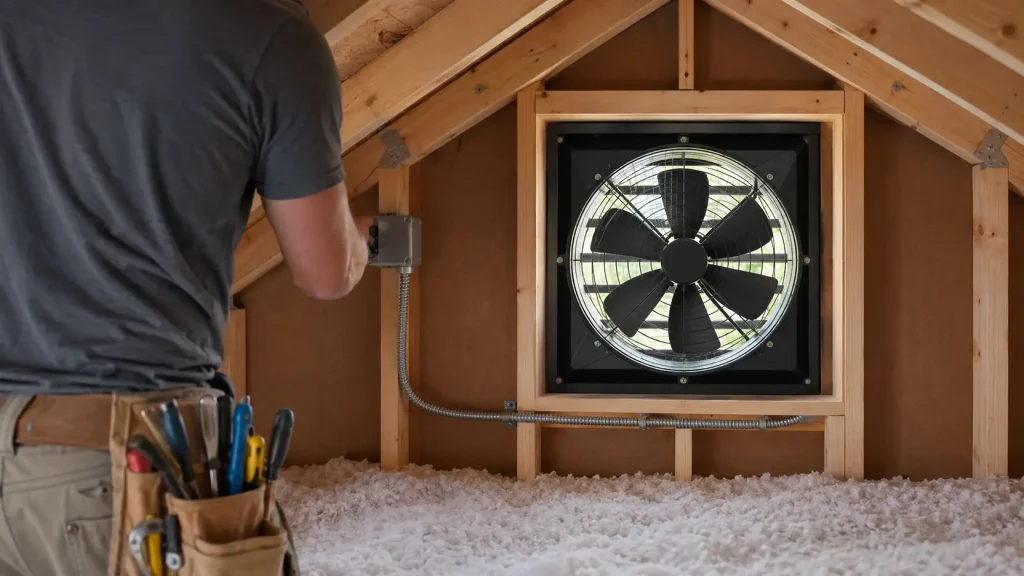
Attic fans are automatic motor-driven equipment installed in a hot, dusty, and difficult-to-access space. The electrical connection, controls, mounting, and service access need to match the listed equipment and the manufacturer’s instructions.
Power and controls
Depending on the model, a fan may use a thermostat, a combined temperature and humidity control, or a manufacturer-specific smart controller. The control must be compatible with the fan motor and installed where it can sense attic conditions as intended. Existing attic wiring should not be assumed suitable simply because a cable or receptacle is nearby.
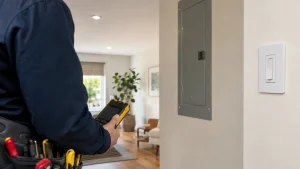
A licensed electrician can verify the available circuit, wiring condition, grounding, overcurrent protection, control location, and disconnecting requirements that apply to the selected equipment and property. Permit and inspection requirements can vary among San Dimas and neighboring jurisdictions, so the installation should be checked against the rules for the actual address.
Mounting and clearances
A gable-mounted fan must be secured to limit vibration and positioned so air can leave through the intended opening. Roof-mounted and solar-assisted products have different structural, weatherproofing, and service considerations. Electrical work should also remain accessible without damaging insulation, ductwork, or stored belongings.
Manufacturer instructions are especially important. QuietCool’s attic fan documentation, for example, treats venting, thermostat wiring, grounding, and operating settings as parts of one system. That is a useful reminder that the fan, controls, wiring, and intake vents cannot be planned separately.
Warning Signs an Existing Attic Fan Needs Attention
An older fan should be inspected if it hums without starting, cycles unpredictably, vibrates heavily, trips a breaker, produces a burning odor, or no longer responds to its control. These symptoms can point to a failed motor, damaged control, obstructed blade, loose mounting, wiring problem, or another electrical fault.
Do not bypass a thermostat, reset a tripping breaker repeatedly, or reach into fan equipment to test it. The unit may start automatically, and attic conditions make electrical and mechanical work more hazardous. Martin’s electrical troubleshooting services are available when the problem involves an existing circuit, control, or fan connection.
What a Professional Evaluation Should Cover
A dependable attic fan plan should answer five questions before installation: What problem is the homeowner trying to solve? Is intake ventilation adequate? Which fan type and capacity fit the attic? Is the existing electrical supply appropriate? Can the equipment be mounted and serviced safely?
The answers determine whether the project needs a new gable fan, replacement controls, added venting by the appropriate trade, electrical repairs, or a different cooling strategy. This approach avoids treating the fan as a stand-alone appliance and helps protect the home’s wiring, roof assembly, and finished spaces below.
For attic fan installation in San Dimas or the surrounding San Gabriel Valley, call (909) 595-1439. Martin’s Electrical & Lighting Company can evaluate the electrical requirements, install compatible fan equipment, and explain the available options clearly.