If you’ve ever been in the middle of blow-drying your hair or running the vacuum when your lights suddenly cut out, you’ve experienced a tripped circuit breaker. While it’s easy to dismiss this as a minor inconvenience, a circuit breaker that trips repeatedly is your home’s way of warning you about a serious electrical issue. Understanding why your breakers trip and what those trips mean for your home’s safety can help you decide when it’s time to reset the breaker yourself and when you need to call a professional electrician.
Los Angeles homeowners face unique electrical demands, from air conditioning systems running through hot summer months to modern home offices packed with electronics. When your electrical panel can’t keep up with demand or develops faults, your circuit breakers respond by shutting off power to protect your home. This guide explains what’s happening inside your panel, why breakers trip, and when a tripping breaker signals it’s time for an upgrade or professional electrical repair.
What a Circuit Breaker Actually Does Inside Your Panel
Your circuit breaker is essentially a safety switch built into your electrical panel. Every circuit in your home has a designated breaker that monitors the flow of electricity through that circuit. When current flows normally, the breaker stays in the “on” position and power reaches your outlets, lights, and appliances without interruption.
The moment a circuit breaker detects too much current flowing through the wires, it automatically flips to the “off” position, cutting power to that circuit. This happens within milliseconds, before the excessive current can overheat the wiring behind your walls. Without this safety mechanism, overheated wires could damage their insulation, spark, and potentially ignite surrounding materials.
Think of your circuit breaker as a guard that monitors traffic on a bridge. When too many vehicles try to cross at once, the guard closes the bridge before it collapses. In the same way, your breaker stops excessive electrical current before it damages your home’s wiring infrastructure.
Modern circuit breakers replaced older fuse systems because they’re reusable and more reliable. When a breaker trips, you can reset it by flipping the switch back to “on.” However, that reset capability doesn’t mean you should ignore repeated trips. If the same breaker keeps tripping, the underlying problem hasn’t been resolved, and your home remains at risk.
Three Main Reasons a Breaker Trips — and What Each Means
Circuit breakers trip for three primary reasons, and each signals a different type of electrical problem. Understanding these distinctions helps you assess whether you’re dealing with a simple fix or a dangerous fault that requires immediate professional attention.
The first and most common cause is an overloaded circuit. This happens when you plug too many devices into outlets served by a single breaker, drawing more current than the circuit was designed to handle. A 15-amp circuit breaker, for example, will trip when the combined draw from your devices exceeds 15 amps. This is the least dangerous scenario but still requires attention if it happens regularly.
The second cause is a short circuit, which occurs when a hot wire touches a neutral wire or makes contact with a grounded surface. This creates a sudden surge of current with very low resistance, causing a massive spike that immediately trips the breaker. Short circuits can result from damaged wire insulation, loose connections, or faulty appliances. You might notice a burning smell or see black marks around outlets when a short circuit occurs.
The third cause is a ground fault, similar to a short circuit but specifically involving the ground wire. Ground fault circuit interrupters (GFCIs) are specialized breakers designed to detect even small ground faults, protecting you from electrical shock. These are required in bathrooms, kitchens, and outdoor outlets where water and electricity might come into contact. When a GFCI trips, it’s preventing a potentially lethal shock.
The Difference Between an Overloaded Circuit and a Short Circuit
Many homeowners confuse overloaded circuits with short circuits, but the distinction matters when diagnosing your electrical issues and determining the urgency of repairs.
An overloaded circuit is a capacity problem. Imagine trying to pour a gallon of water into a half-gallon container—the container isn’t damaged, but you’re simply asking it to handle more than it can. When you run your space heater, television, gaming console, and phone charger all from the same circuit, you might exceed the circuit’s amperage rating. The breaker trips to prevent the wiring from overheating, but nothing is actually broken or faulty. Overloads typically happen when you add a new high-draw appliance or plug in too many devices at once.
A short circuit, by contrast, is a safety emergency. It occurs when electricity finds an unintended path between conductors, usually because insulation has failed or wires have come loose inside an outlet, switch, or appliance. The resulting current surge is instantaneous and dangerous. Short circuits generate heat and sparks that can ignite fires within seconds if the breaker doesn’t trip.
You can often identify which problem you’re facing by observing when and how the breaker trips. If your breaker trips when you turn on a specific appliance or plug in one too many devices, you’re likely dealing with an overload. If a breaker trips randomly or immediately when you flip it back on, you probably have a short circuit that needs professional diagnosis. Short circuits also tend to produce visible signs like scorch marks or a distinct burning odor.
Warning Signs Your Electrical System Is Overloaded
Before a circuit breaker trips, your home’s electrical system typically gives you warning signs that it’s struggling to handle the load. Learning to recognize these signals can help you take action before you’re dealing with repeated outages or dangerous conditions.
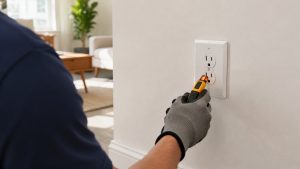
Warm or discolored outlets and switch plates are one of the most telling signs. If you touch an outlet cover and it feels unusually warm, or if you notice brown or black discoloration around the outlet, wiring inside is getting hot enough to damage plastic components. This isn’t normal wear—it’s evidence that too much current is flowing through connections that may be loose or undersized for the load.
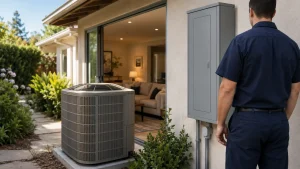
Flickering or dimming lights, especially when you turn on an appliance, indicate your electrical system is at capacity. When your air conditioner kicks on and your lights momentarily dim, it means that high-draw appliance is pulling so much power that it’s affecting other circuits. While a slight dimming might happen occasionally in older homes, frequent or pronounced flickering means your panel or circuits can’t adequately distribute power.
Buzzing sounds from outlets, switches, or your electrical panel suggest loose connections or arcing electricity. These sounds often precede more serious failures. Similarly, if you smell burning plastic or notice a persistent electrical odor near your panel or outlets, don’t wait for a trip to investigate—these are signs of immediate danger.
If you frequently need to unplug one device to use another, or if you’ve accumulated power strips throughout your home to expand outlet capacity, your electrical system is fundamentally inadequate for your needs. These workarounds don’t actually increase the available power; they just concentrate more demand on circuits that may already be overloaded.
Why Constantly Resetting a Breaker Is a Fire Hazard
When a breaker trips, many homeowners simply walk to the panel, flip the switch, and go about their day. If this happens occasionally, it’s serving its protective function. But when you find yourself resetting the same breaker multiple times per week—or worse, per day—you’re not solving the problem. You’re temporarily bypassing a safety system that’s trying to prevent a fire.
Each time a breaker trips and you reset it without addressing the underlying cause, you’re allowing the dangerous condition to continue. If an overloaded circuit made the breaker trip, resetting it just means the circuit will overload again. The wiring behind your walls heats up every time it’s overloaded, degrading the insulation gradually until it fails completely. Damaged insulation can expose live wires that spark and ignite nearby wood framing or insulation material.
If a short circuit or damaged wire is causing the trips, the danger is even more immediate. Every time you reset the breaker, you’re re-energizing a fault that’s creating heat and potentially sparks. Some homeowners make the critical mistake of holding a tripped breaker in the “on” position or replacing a 15-amp breaker with a 20-amp breaker to stop the trips. Both actions disable the safety system and dramatically increase fire risk.
The National Fire Protection Association identifies electrical failures and malfunctions as a leading cause of home fires in the United States. Many of those fires begin in walls where overheated wiring has degraded, often in homes where breakers tripped repeatedly but the underlying problem was never resolved.
If a breaker trips more than once, schedule an inspection with a licensed electrician before resetting it again. The cost of a service call is minimal compared to the cost of fire damage or the risk to your family’s safety.
When a Tripping Breaker Means You Need a Panel Upgrade
Sometimes a tripping breaker isn’t warning you about a fault—it’s telling you that your electrical panel wasn’t designed for the way you live today. If your Los Angeles home was built more than 30 years ago, there’s a good chance your electrical panel is undersized for modern electrical demands.
Older homes typically have 100-amp or even 60-amp service panels with fewer circuits than today’s building codes require. When these panels were installed, homes didn’t have central air conditioning, multiple large-screen televisions, home offices full of computers and monitors, electric vehicle chargers, or smart home systems. A typical household now uses two to three times the electricity it would have in the 1980s.
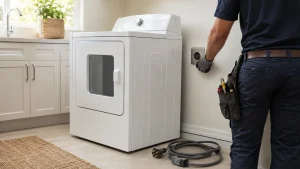
If you trip breakers regularly when running common combinations of appliances—say, the air conditioner and the dryer at the same time—your panel simply can’t deliver enough power to meet your needs. Adding more circuits might help distribute the load, but if your total service capacity is maxed out, you’ll need a panel upgrade to a 200-amp system.
Other signs you’ve outgrown your panel include having to carefully schedule when you use high-draw appliances, relying on dangerous extension cords because you don’t have enough outlets, or being unable to add new circuits for home improvements like a kitchen remodel or EV charger.
Los Angeles building codes now require certain safety features that older panels lack, including arc-fault circuit interrupters (AFCIs) for bedroom circuits and proper grounding systems. Upgrading your panel doesn’t just solve your capacity problems—it brings your home up to current safety standards, protecting your family and increasing your property value.
Modern panels with properly sized service and adequate circuits virtually eliminate nuisance tripping while providing the protection your home needs. If you’re resetting breakers because you’ve exceeded your panel’s capacity, an upgrade is the permanent solution.
Call Martin’s Electrical to Diagnose Your Tripping Breaker
While you can safely reset a tripped breaker yourself, diagnosing why it tripped and fixing the underlying problem requires expertise. Electrical systems are complex, and working inside your panel or behind walls carries serious shock and fire risks without proper training and equipment.
A licensed electrician from Martin’s Electrical can perform a comprehensive evaluation of your electrical system, identifying whether you’re dealing with an overloaded circuit, a short circuit, faulty wiring, a damaged appliance, or an inadequate panel. We use thermal imaging to detect hot spots behind walls, test circuits for proper grounding and load capacity, and inspect connections for signs of arcing or corrosion.
If we find an overloaded circuit, we can redistribute your electrical loads, add new circuits to handle high-draw appliances separately, or recommend a panel upgrade if you’ve outgrown your current system. If we discover a short circuit or damaged wiring, we locate and repair the fault before it causes a fire. When we find aging breakers that have lost their trip sensitivity, we replace them with modern, code-compliant equipment.
For Los Angeles homeowners dealing with repeated breaker trips, waiting to call a professional only increases the risk. The longer a problem persists, the more damage occurs to your wiring and the higher the chance of a dangerous failure. Call Martin’s Electrical today to schedule a diagnostic inspection. Our experienced electricians will get to the root of your breaker problems, explain your options clearly, and provide reliable repairs that restore safety and convenience to your home.
Whether you need circuit repairs, load balancing, a complete panel upgrade, or a second opinion on work another contractor quoted, Martin’s Electrical delivers honest, professional electrical services Los Angeles homeowners trust. Don’t let a tripping breaker put your home at risk—let our team protect what matters most. Visit our blog for more electrical safety tips, or contact us now to schedule your service appointment.