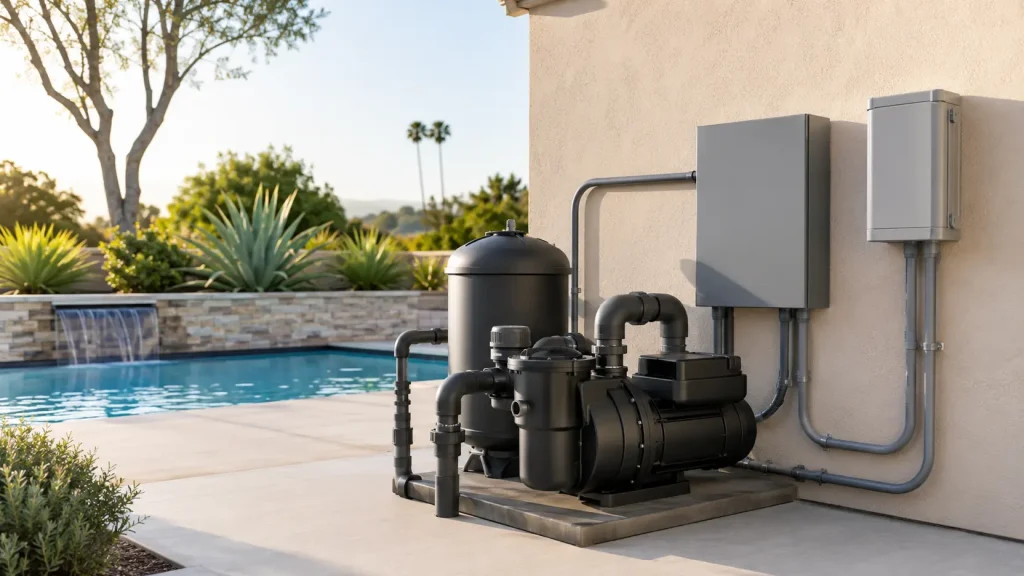
A San Gabriel Valley homeowner can choose a new variable-speed pool pump, schedule the plumbing work, and still discover that the existing electrical connection is not ready for the replacement. The old pump may use a different voltage, the protective device may not match the new equipment, or years of outdoor exposure may have affected the wiring and enclosures. Safe pool pump electrical wiring starts with the new pump’s specifications and a review of the complete pool-equipment circuit.
The practical first step does not require opening anything electrical. Photograph the new pump’s nameplate, save its installation manual, and note every connected component, including timers, automation controls, heaters, lights, and sanitizing equipment. A licensed electrician can use that information to determine whether the existing circuit is suitable before the old pump is removed.
Pool pump electrical wiring must match the actual equipment
Pool pumps are not electrically interchangeable simply because they fit the same plumbing. Voltage, full-load current, connection method, control requirements, and protective-device instructions can differ by model. Pentair’s current IntelliFlo3 product specifications, for example, list a 208-to-230-volt input range for one model. Other pumps can have different requirements, so the manufacturer’s nameplate and manual must control the planning decision.
An electrician compares those requirements with the breaker, conductors, disconnecting means, timer or automation system, and available panel capacity. Martin’s electrical wiring and rewiring services cover dedicated circuits and code-compliance upgrades when an existing route or connection cannot safely support the new equipment.
Why an older pool circuit may need more than a new connection
Voltage and conductor requirements may differ
A replacement pump might not use the same voltage or current as the unit it replaces. Changing a motor connection without verifying the entire circuit can create a mismatch involving the breaker, conductor size, controls, or equipment configuration. The answer cannot be determined from wire color, outlet shape, or the setting on the old pump alone.
Wet-area protection must work as a system
Pool equipment operates where moisture, grounded surfaces, and people are close together. The U.S. Consumer Product Safety Commission advises pool owners to have a qualified pool and spa electrician inspect equipment and emphasizes GFCI protection for pumps and other pool electrical equipment. Martin’s guide to where GFCI protection is used around a home provides additional context for wet and outdoor locations.
A breaker that trips after a pump replacement should not be treated as an annoyance to bypass. It can indicate an equipment fault, wiring problem, incorrect configuration, damaged conductor, moisture issue, or incompatibility between components. Repeatedly resetting it does not identify the cause.
If a new pump is being planned or the existing pool circuit is tripping, call Martin’s Electrical & Lighting Company at (909) 595-1439 to have the equipment specifications and circuit evaluated before the connection is changed.
Grounding and bonding serve different purposes
Grounding and equipotential bonding are related safety measures, but they are not substitutes for one another. Pool systems can involve the pump motor, metal equipment, conductive parts, and other components around the water. A licensed electrician should verify that the installation follows the equipment instructions and the requirements that apply to the property.
Homeowners should not open a pump’s wiring compartment, remove a panel cover, test energized terminals, alter a bonding connection, or substitute an adapter to make a new motor run. Pool electrical work combines energized equipment with a wet environment, leaving little room for guesswork.
Signs the existing pool equipment circuit needs attention
Schedule professional electrical troubleshooting if the pump breaker trips repeatedly, the timer or disconnect buzzes, equipment starts intermittently, an enclosure is cracked, or corrosion and moisture are visible around electrical components. Heat discoloration, a burning odor, damaged conduit, or loose covers also warrant prompt attention.
If anyone feels tingling or a shock in the water, stop using the pool immediately. Do not touch metal ladders or equipment while in the water, and do not enter the water to assist someone until power has been shut off safely. The CPSC recommends calling 911 during a suspected electrical-shock emergency and having the system inspected before the pool is used again.
Permits and current California requirements
The California Building Standards Commission identifies the 2025 California Electrical Code as Part 3 of Title 24, effective January 1, 2026. The state also explains that California occupancies can be subject to amendments and ordinances adopted by local jurisdictions. That means permit, inspection, equipment-location, protection, and connection requirements can vary with the city and the project.
A pump-only replacement may have a different scope from relocating equipment, adding automation, installing a heater, changing voltage, or rebuilding the equipment pad. A licensed electrician can confirm what the local authority requires and coordinate the electrical portion with the pool professional.
Plan the electrical review before the pump is delivered
The most useful takeaway is to treat a pool pump replacement as an equipment-matching project, not a plug-and-play swap. Provide the electrician with the exact model, manual, equipment-pad photos, and a list of every connected control. Martin’s electrical panel services can also address capacity or breaker-space concerns if the evaluation extends beyond the pool circuit.
For pool pump electrical wiring in San Dimas or the surrounding San Gabriel Valley, call Martin’s Electrical & Lighting Company at (909) 595-1439. A careful pre-installation review can align the new pump with the circuit, wet-area protection, controls, and current local requirements without relying on assumptions from the old equipment.