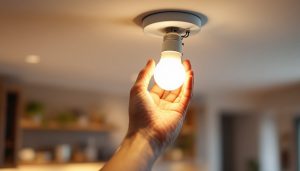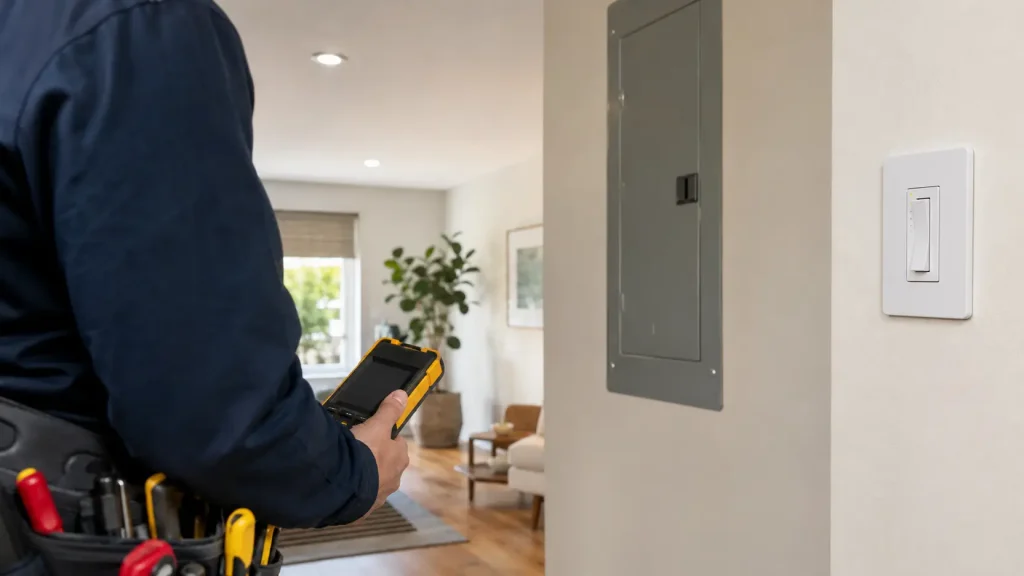
A homeowner replaces several recessed bulbs with LEDs, turns on the dimmer, and suddenly loses power to the lighting circuit. Resetting the breaker may restore the lights for a moment, but the trip returns at a particular dimming level or when another device starts. When an arc fault breaker is tripping with LED lights, the LEDs may be part of the pattern, but they are not proof that the breaker is defective.
The most useful first step is to record exactly what changed. Note the LED bulb or fixture model, dimmer model, breaker brand, rooms affected, and whether the trip happens at startup, at a certain brightness, or only when another load is operating. That information gives a licensed electrician a much better starting point than repeatedly resetting the breaker.
Why an arc fault breaker may trip with LED lights
An arc-fault circuit interrupter, or AFCI, monitors a branch circuit for electrical patterns associated with dangerous arcing. The National Fire Protection Association explains that AFCIs shut off electricity when an arcing condition is detected. Like a conventional breaker, an AFCI can also open the circuit for other conditions depending on the device and installation.
LED lighting uses electronic drivers to convert and regulate power. Dimmers also control the electrical waveform rather than simply reducing wattage. A compatible, properly installed combination should operate normally, but a lighting product, dimmer, connection, or wiring condition can create a pattern that requires diagnosis.
Siemens identifies two major sources of unexplained AFCI or GFCI trips in its AFCI/GFCI Circuit Breaker Diagnostic Guide: wiring problems and incompatibility with electronic devices. The guide notes that damaged wiring, loose connections, incorrectly wired circuits, or excessive electrical noise from a load can contribute. That is why replacing the breaker without finding the cause is not a dependable solution.
Four areas an electrician evaluates
LED and dimmer compatibility
Not every LED is designed for dimming, and a dimmable lamp is not automatically compatible with every dimmer. The driver, dimmer type, minimum load, fixture, and number of lamps can affect performance. Lutron provides an LED compatibility tool for checking tested lamp and dimmer combinations, which illustrates why exact model numbers matter.
Common compatibility symptoms include flickering, a limited dimming range, delayed startup, buzzing, or operation that changes as brightness is adjusted. These symptoms do not establish the reason for an AFCI trip, but they help an electrician reproduce the condition and separate a lighting-control issue from a broader circuit fault.
Loose, damaged, or incorrect connections
A trip that begins after a lighting change can still reveal a connection problem in a switch box, fixture, junction box, or another part of the branch circuit. Loose terminations and damaged insulation deserve attention because they can produce the very conditions an AFCI is intended to detect. Martin’s broader guide to why an arc fault breaker keeps tripping explains other circuit and appliance causes that may be involved.
If the breaker will not reset, trips with the lights switched off, or is accompanied by heat, discoloration, crackling, or a burning odor, leave the circuit off. Do not remove the panel cover, swap breaker types, bypass AFCI protection, or move conductors between breakers to test a theory.
The breaker’s recorded trip information
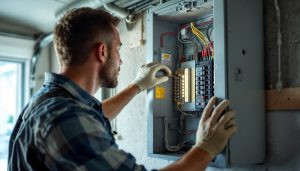
Some AFCI and dual-function breakers provide a diagnostic light or stored trip indication. The meaning and retrieval process depend on the manufacturer and model. Schneider Electric, for example, directs users of certain QO and Homeline devices to use the manufacturer’s True-Fault LED or diagnostic procedure to identify the last recorded trip.
A homeowner can safely photograph the breaker face and note any visible light pattern from outside the closed panel. Interpreting it should follow the correct manufacturer documentation. A blink pattern from one product should not be applied to another brand or generation.
If an LED upgrade or dimmer change is followed by repeated AFCI trips, call Martin’s Electrical & Lighting Company at (909) 595-1439. Their licensed electricians can evaluate the lighting equipment and protected circuit together instead of treating either one as the automatic culprit.
Everything else supplied by the circuit
The light switch may not be the only load on the affected circuit. Receptacles, electronics, fans, or equipment in another room can share the branch circuit. A trip that seems tied to one LED fixture may require a particular combination of loads or may originate elsewhere.
Professional electrical troubleshooting focuses on reproducing the event, identifying what the breaker recorded, and checking the connected equipment and wiring. The objective is to distinguish a genuine wiring or equipment fault from a compatibility problem without removing required protection.
What to document before the service call
Keep the investigation safe and observational. Write down the date and time of each trip, which switches were on, the dimming level, and what other equipment was operating. Photograph product labels that can be reached without opening electrical enclosures. Save packaging or receipts for recently installed bulbs, fixtures, drivers, or controls.
Also note whether the problem started immediately after an installation or appeared later. A new symptom after months of normal operation can point the diagnostic process in a different direction from a combination that never worked correctly.
Martin’s lighting installation and repair services cover fixture, recessed-lighting, dimmer, and lighting-performance concerns. If the evaluation identifies damaged wiring or another branch-circuit issue, the repair can be coordinated with the lighting correction.
Do not solve the trip by removing protection
An AFCI trip is a safety signal, even when the eventual cause is equipment compatibility rather than damaged wiring. Replacing an AFCI with a standard breaker, installing an incompatible breaker, or repeatedly resetting a circuit without diagnosis can leave the underlying condition unresolved. Applicable code, permit, and protection requirements vary by jurisdiction and project scope, so the correction should be based on the property and current local requirements.
For an arc fault breaker tripping with LED lights in San Dimas or the surrounding San Gabriel Valley, call Martin’s Electrical & Lighting Company at (909) 595-1439. Bring the bulb, fixture, dimmer, and breaker model information so the electrician can evaluate compatibility, connections, diagnostic indicators, and the full circuit without guessing.